
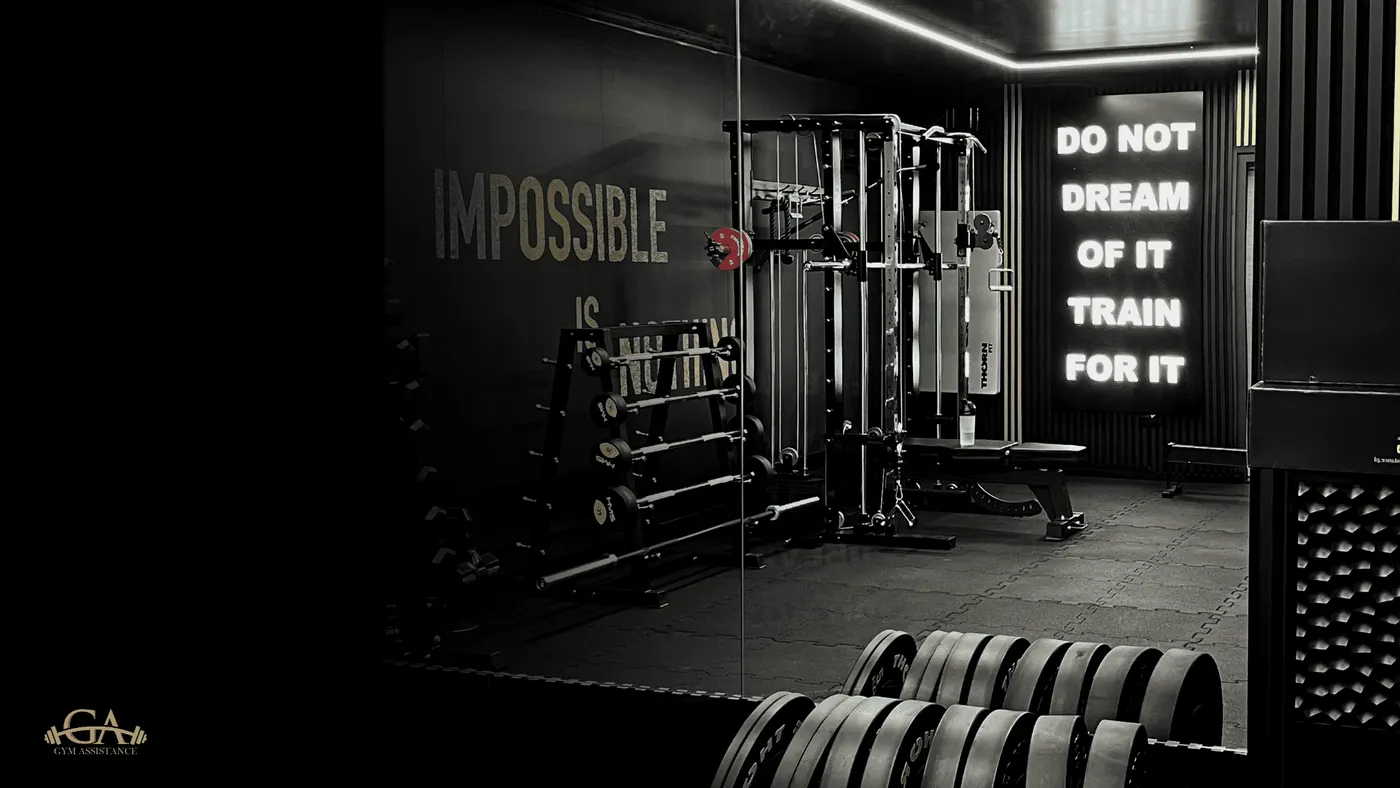
Starting to plan a home gym — where do you begin?
Not by buying a barbell. Not by scrolling Instagram. You start by measuring the space and asking yourself one question: what is this gym actually for?
The answer decides everything — the size, the equipment, the budget.
Step 1 — Define your training goal
Different goals mean completely different gyms.
| Goal | Key equipment | Min. floor area |
|---|---|---|
| Strength (building muscle) | Rack, barbell, bench | 12–15 m² |
| Conditioning and cardio | Treadmill / bike + mats | 10–12 m² |
| Functional training | Kettlebells, TRX, mat | 12–20 m² |
| A bit of everything | Rack + cable + cardio | 20–30 m² |
| CrossFit / high intensity | Rig, Olympic barbell, rower | 25–40 m² |
If you are still weighing up how much room you really need, our guide on how to choose a container gym size walks through the same logic for a standalone unit.
Step 2 — Measure and sketch a plan
Grab a tape measure and note down:
- Length × width
- Ceiling height — the dimension everyone forgets. A standard rack is ~220 cm, an Olympic rack ~230 cm. Pull-ups need at least 240 cm of clearance.
- Where the sockets are
- Where the windows are (a treadmill facing a window means glare; a mirror facing a window means reflections you’ll hate)
Draw a 1:20 scale sketch and drop in the footprint of each piece of kit before you buy anything. It is far cheaper to discover a clash on paper than on delivery day.
Step 3 — Choose the flooring (this is the foundation)
Gym flooring is the single most important element, and it’s the one most people treat as an afterthought.
EPDM rubber in 1×1 m tiles, 20–30 mm thick — the standard. It runs from £6–12/m². It protects the slab underneath, absorbs dropped weights and cuts noise for the rest of the house.
➜ Under the cardio zone: 15–20 mm is plenty
➜ Under free weights: 20 mm minimum, 30–40 mm for deadlifts
➜ Under a spin bike: a dedicated anti-vibration mat
Avoid: thin EVA puzzle mats (they shift under heavy kit) and carpet (it soaks up sweat and gets shredded by equipment).
For a deeper breakdown of thicknesses and materials, see our home gym flooring guide.
Step 4 — Lighting and ventilation
Lighting:
- At least 300 lux for normal training, 500 lux for heavy sessions
- Ceiling LED panels at 4000K (neutral white) — easy on the eyes
- Optional: LED strips behind mirrors for a bit of atmosphere
Ventilation:
- A window or trickle vent is the bare minimum
- In a garage with no windows: a fan or air conditioning (it adds comfort and protects your kit from damp — the real enemy of a UK garage gym)
A converted garage or spare room rarely has either sorted out of the box. If you’re working with an awkward space, our garage gym conversion and basement gym pages cover the ventilation and damp-proofing side in detail.
Step 5 — Buy equipment in order of priority
Don’t buy everything at once. Start with the core.
Core (covers 90% of your training):
- Power rack or half rack — from £500–1,600
- Olympic bar, 20 kg — from £100–400
- Rubber-coated plates, 100 kg — from £240–600
- Adjustable FID bench — from £160–600
- Rubber flooring — from £300–800 (depends on the floor area)
Build-out (in order of value): 6. Adjustable dumbbells or a 2–32 kg set — from £200–800 7. Pull-up bar (if not in the rack) — from £40–160 8. Kettlebells, 16/24/32 kg — from £80–240 9. Standalone cable machine or rack attachment — from £600–1,600 10. Cardio (bike / treadmill / rower) — from £400–3,000
A few hundred pounds spent well on the core beats a room full of half-used machines.
Step 6 — Mirror and details
A mirror is underrated. It sharpens your technique and makes the room feel twice as big. Go for at least 100×150 cm, wall-mounted or framed.
Other details worth the money:
- A barbell and plate rack (tidy gear = safer gear)
- A wall clock or interval timer
- A Bluetooth speaker or a fixed audio setup
- A first-aid kit, and ice in the freezer if you train hard
How much does a home gym cost?
| Tier | Cost | Floor area |
|---|---|---|
| Mini (garage, strength only) | from £1,600–3,000 | 12–18 m² |
| Standard | from £4,000–8,000 | 20–30 m² |
| Premium (fully kitted) | from £10,000–20,000 | 30–50 m² |
These figures cover the equipment, flooring and basic fit-out. They do not include building work or the room itself.
A quick reality check: a standard UK home-gym fit-out comes in around the same as a single year’s membership for a family of four at a mid-range club — except you own it, it’s a 30-second walk from your kitchen, and it never closes. If you want to put numbers against your own plan, the ROI calculator does the maths.
The figures above are general guidance, not a fixed quote — local labour rates and whether you need any electrical work (a new circuit for a treadmill, for example, is a job for a qualified electrician) will move the total.
No room indoors? A garden Gym Box solves it
If your house, garage or basement genuinely can’t take a gym — or you’d rather not give up the space — a Gym Box is a self-contained steel module that drops into the garden. Insulated sandwich-panel construction, heating, lighting and flooring already in place: a finished training room from day one, no conversion required.
You can see how that works in practice in our garden gym in Skawina and home gym in Raszyn case studies — real builds, delivered ready to use.
Want help designing your gym — indoor conversion or a garden Gym Box? Book a free consultation — we’ll tell you what to put where and what it costs, with a reply within 24 hours. Prefer to see prices first? Start with the online quote.