
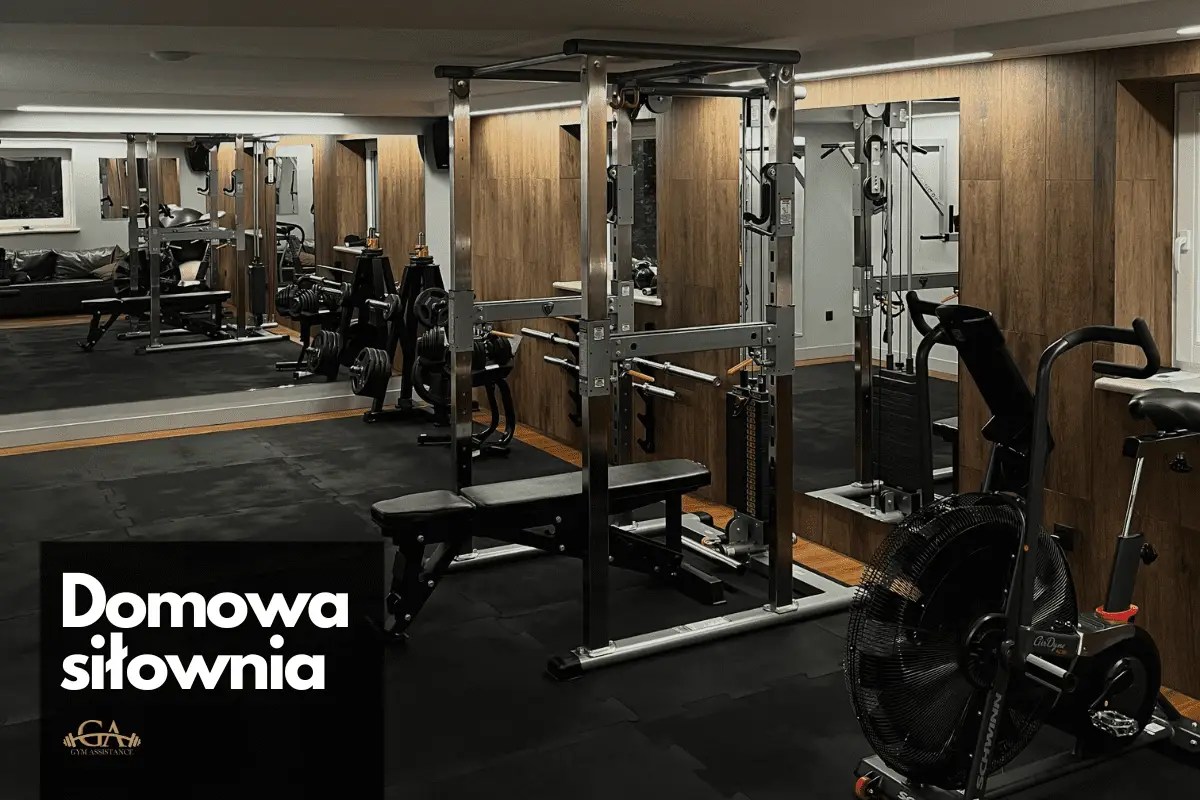
The basement — an underrated space below the house
Most basements end up as storage. Old bikes, “we might use these someday” boxes, paint tins. Meanwhile 20–40 m² are waiting for a better use.
A basement gym has one big advantage that’s rarely mentioned: acoustic isolation. You can train with music at full volume at 6 am — without waking anyone up.
Basement challenges — and how we solve them
Damp — the biggest issue. Solutions: dehumidifiers, mechanical ventilation, hydrophobic wall paints, special flooring mats with ventilation channels.
Low ceiling — typically 2.1–2.3 m. We select equipment to suit the room height. Wall-built racks instead of free-standing. Low pulley instead of high. Side pull-up bar instead of ceiling-mounted.
No natural light. We compensate with cool-temperature LED lighting (5,500–6,500 K) which is energising and creates a sense of space. Adjustable colour and brightness.
Entrance / stairs. We carry equipment in pieces and assemble on site — that’s standard for us.
Example layout for a 20 m² basement gym, 2.2 m ceiling
- Wall-built rack (2.0 m height) with cable system
- Free weights 5–30 kg on rack
- Adjustable bench
- Kettlebells
- Rubber flooring with ventilation channels
- Mirror on the wall opposite the rack
- Axial fan + dehumidifier
Technical requirements
| Parameter | Requirement |
|---|---|
| Minimum ceiling height | 2.0 m (2.2 m+ preferred) |
| Minimum floor area | 12 m² |
| Ventilation | Required (mechanical or assisted) |
| Target humidity | below 60% |
| Power | 230V (UK), preferably on a dedicated circuit |
FAQ
Can I install air conditioning in the basement? Yes, a mini-split (split unit) works brilliantly in basements and solves both summer cooling and partial dehumidification.
How will the equipment get in? Through standard basement doors — we assemble the rack on site. No issue.
How much does a basement gym cost? From around £3,000 for a basic version with flooring and equipment. With mechanical ventilation + dehumidifier — from £4,000.