
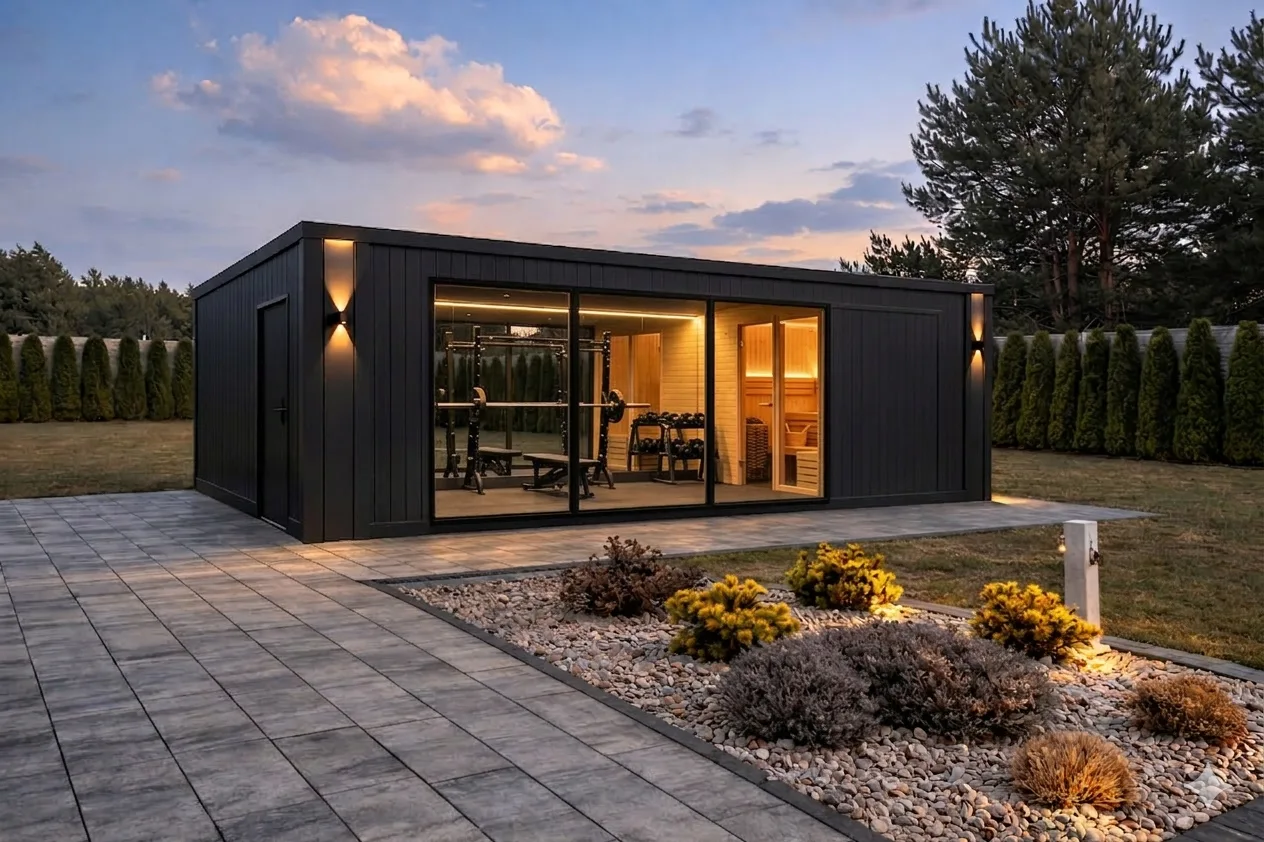
“You won’t want to train out there once it’s freezing” — that’s the first thing people say in January when they see a Gym Box in the garden for the first time. The honest answer: you can, with zero compromise — through a damp, frosty British winter, the odd cold snap included. But three things have to be right: insulation, heating and ventilation. Everything else is just logistics.
Here’s the concrete scenario. It’s a cold, wet evening, you have 60 minutes to train — what does it actually look like?
Three pillars of winter comfort
1. Insulation — the foundation of everything
Standard Gym Box ➜ 120 mm of mineral wool in the walls, floor and roof. Whole-envelope U-value: around 0.28 W/m²K — better than the requirement for habitable rooms under current UK Building Regulations (Part L).
In practice ➜ at -5°C outside and +20°C inside, heat loss for an 8×3 module is roughly 1.5–2 kW. For a 7×5 ➜ about 2.5 kW. Those are real figures, not marketing.
See how a container gym performs in winter ➜
2. Heating — what to buy
Three options we genuinely recommend:
| Solution | Output | Unit cost | Pros | Cons |
|---|---|---|---|---|
| Electric convector heater | 2–3 kW | from £80 | Cheap, simple, no maintenance | Expensive to run |
| Split air-conditioner with heat pump | 3.5 kW (12,000 BTU) | from £700 | Heats and cools, COP 3–4, smart control | Needs a dedicated 13A circuit |
| Air-to-air multi-split heat pump | 5 kW | from £1,400 | Highest COP, two zones | Needs a heavier supply |
The most common choice ➜ a split air-conditioner with a heat pump (e.g. Mitsubishi MSZ-AP35 or Samsung WindFree). One unit covers the whole year: heating in winter, cooling in summer.
3. Ventilation — so it stays dry
This matters more in Britain than the cold does. Without mechanical ventilation, winter windows fog up and within a month you can get mould. Standard ➜ a heat-recovery ventilation unit (MVHR), 100–200 m³/h, recovering 80–90% of the heat. Unit cost: from £600. Running cost: negligible (a 30 W fan).
”Training on a frosty evening” — step by step
Step 1: 30–40 minutes before you train ➜ switch the heating on
From the app on your phone (smart air-con) you set the target temperature to 18–19°C. The signal goes through ➜ the unit runs at full output. Time to bring an 8×3 module from 5°C (where it sits after a cold day) up to 18°C ➜ 25–35 min. For a 7×5 ➜ 35–45 min.
Step 2: Throw on your kit and step outside
30 seconds across the garden — instead of a 25-minute drive to the gym. You leave outdoor shoes in the entrance area and slip on your trainers.
Step 3: Train
Inside: 18–19°C, dry (the MVHR is running), 4000K LED lighting. You train for 45–60 minutes in full comfort. The key bit ➜ while you train your body adds another 200–400 W of heat, so the heat pump throttles back to maintenance mode.
Step 4: After the session ➜ the app drops the temperature to 12°C
“Stand-by” mode ➜ the module never gets cold or damp, and you don’t waste energy holding it warm overnight.
The real cost of a single session in a cold snap
| Item | Time | Draw | Cost (at 28p/kWh) |
|---|---|---|---|
| Heating from 5°C to 18°C (8×3, COP 3) | 30 min | 1.5 kWh | £0.42 |
| Maintenance during training | 60 min | 0.8 kWh | £0.22 |
| LED lighting (60 W) | 60 min | 0.06 kWh | £0.02 |
| MVHR (30 W) | 90 min | 0.05 kWh | £0.01 |
| Total | ~2.4 kWh | ~£0.67 |
For a 7×5 with more kit ➜ around £1.00–1.50 per session in a genuine cold snap. On a typical British winter day (5–7°C) ➜ £0.40–0.70 per session.
For comparison: a 25-minute drive each way to a commercial gym ➜ roughly 10 miles × 2 = 20 miles, plus 50 minutes of your day, plus the membership. The Gym Box wins on time before it even wins on money.
What to avoid — the three most common winter mistakes
- Switching the heating off completely after a session ➜ the interior goes cold, the next warm-up takes 90 minutes and burns 4× more energy than just holding 12°C
- Skipping the MVHR and “cracking a window to air it out” ➜ you lose 80% of your heat, pull damp air in from outside, and end up with condensation on the frames — a real risk in the British climate
- Leaving water sitting in pipework or a tank over a hard frost ➜ split valves. Either hold +5°C all winter, or drain it down after the season
Does it hold up? Yes — 200+ owners say so
We’ve built gyms for clients across northern, exposed sites — from the Baltic coast to the foot of the Tatras in Poland, where winters bite far harder than anything Britain throws up. Those modules have been in daily use since 2019. Average winter-comfort rating in our 2025 owner survey (n=87): 4.8/5. Our UK and Irish customers, with their milder but wetter winters, report the ventilation spec matters even more than the heating.
Read owner reviews ➜ | Browse the Gym Box range ➜
Want to spec this for your own garden?
Every site is different ➜ prevailing wind, sun exposure, the power supply you’ve got. In a 20-minute call we’ll work out which heating and ventilation set-up is right for you, and put a fixed price on it.
Free consultation · Reply within 24 hours ➜ /en/kontakt/ or request a quote ➜ /en/wycena/