
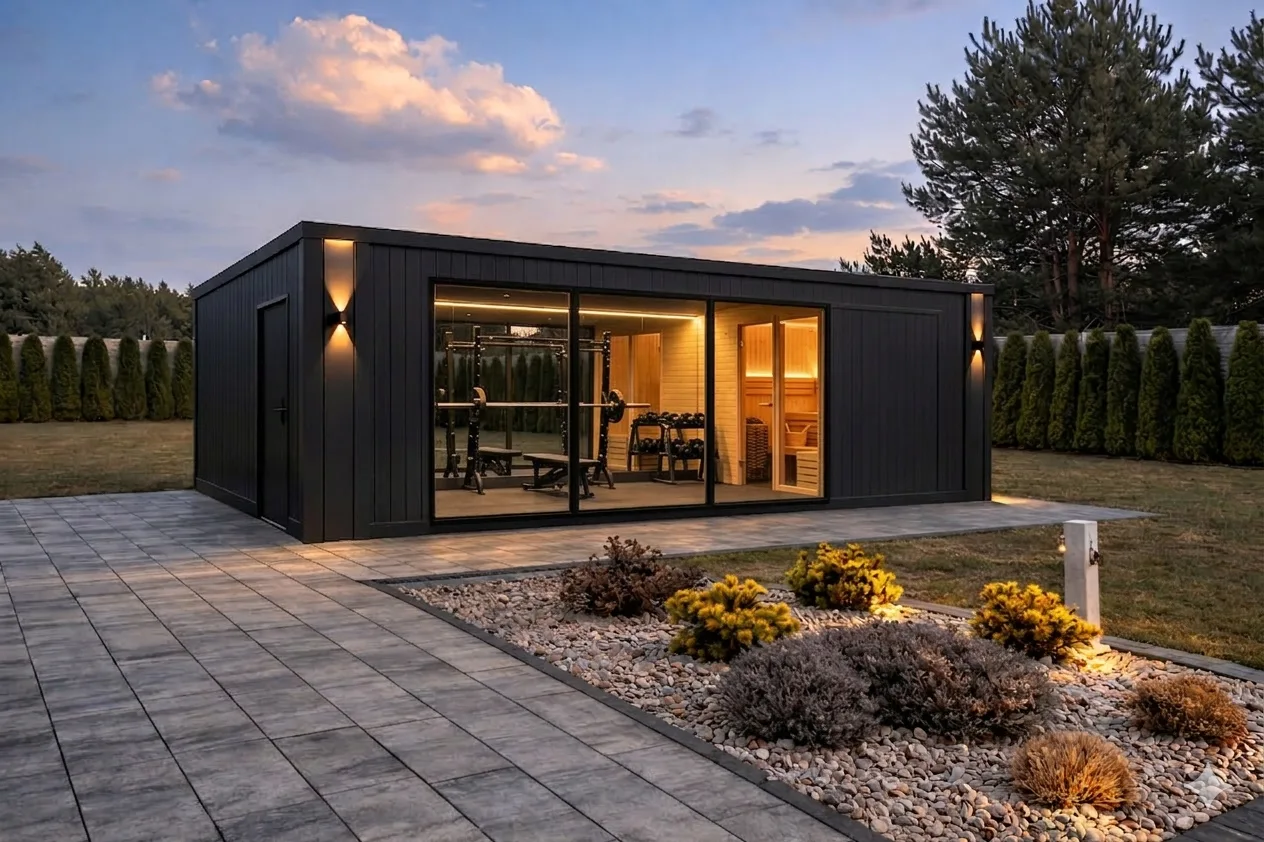
A UK residential developer in 2026 no longer sells square footage — it sells a lifestyle. An on-site gym in the shared amenity space is now one of the buyer features that consistently shows up in agent surveys as a “deciding factor” in the premium and upper-mid market. Yet the traditional approach — a fit-out room in the basement or undercroft — costs from £40,000 to £80,000 to convert, carries ongoing service-charge costs, and often stands empty for the first 12–18 months after completion.
A Gym Box for developers solves both sides of the equation — the cost side and the tax side. This article walks through how to account for the investment in the books of a project SPV, how the VAT works, and why a relocatable steel module is treated differently from a brick-built amenity room.
Tax treatment depends on your structure, your scheme and current legislation. The numbers below are illustrative — always confirm the position with your accountant before you commit.
What a Gym Box is in the developer’s books
A Gym Box is a steel sandwich-panel module that is delivered ready-made and bolted to a pad or anchored feet. Because it is relocatable plant rather than a permanent structure, it usually sits in the books as one of:
- A fixed asset — if it stays in the ownership of the management company that runs the development,
- An element of the shared infrastructure — costed into the build as an amenity and recovered through the sale price,
- A sale-and-leaseback asset — sold to the RMC or freeholder once the scheme completes.
Each model has different tax implications. The most common in 2025–2026 is model 2 — the cost is built into the sale price of the flats.
VAT and recovery
For a VAT-registered developer, a Gym Box purchase carries the standard 20% VAT on the net price. In most new-build residential schemes the input VAT is recoverable, because:
- the sale of new dwellings is zero-rated for VAT → there is a link to a taxable (zero-rated) supply,
- shared amenities (the gym, play areas, internal roads) are treated as part of the cost of building out the scheme.
➜ In practice: on a Gym Box 7×5 from £21,000 +VAT the developer reclaims the £4,200 input VAT in the period of the invoice. The mix of zero-rated, exempt and standard-rated supplies on any given scheme is fiddly — get your VAT adviser to confirm the recovery position.
Capital allowances — relieving the cost faster
This is where the relocatable module earns its keep. A brick-built basement gym is largely structural — much of the spend gets little or no capital-allowance relief. A Gym Box, by contrast, behaves like plant: the unit and a high share of its contents (air conditioning, lighting, gym equipment, flooring) typically qualify for plant and machinery allowances, and a limited company can usually offset a large slice in the year of purchase through the Annual Investment Allowance (AIA).
| Item | Brick-built basement gym | Gym Box (relocatable) |
|---|---|---|
| Nature | Mostly structural | Plant & machinery |
| Capital-allowance pool | Limited / partial | High share qualifies |
| Relief in year 1 | Slow (writing-down) | Up to full cost via AIA |
| Corporation-tax saving on £24,000 | Small in year 1 | ~£4,500–6,000 in year 1* |
*At 19–25% corporation tax, depending on profits. The exact split between qualifying and non-qualifying spend needs a capital-allowances review — your accountant can run it against the invoice.
For a developer that retains the SPV for 3–5 years after handover (warranty, snagging, service), bringing relief forward is a genuine reduction in the corporation-tax bill.
Operating lease — payments through the P&L
The alternative is an operating lease through the SPV. In that case:
- the lease payments are deductible in the P&L as they fall due,
- the VAT on each payment is recovered in the relevant period,
- the asset stays off the SPV’s balance sheet — useful when development-finance covenants are tight.
For a Gym Box 7×5 studio-level package from £28,500 +VAT turnkey a 48-month lease lands at roughly £650/month, fully deductible. At the end of term the SPV buys it out for a nominal sum or transfers it to the RMC. The detail is in our finance options guide and in putting a container gym through your business.
Worked example — a 50-flat scheme
Assumptions: a developer builds a boutique scheme of 50 flats (upper-mid, ~£450/sq ft, average 600 sq ft per unit). Instead of converting an 850 sq ft undercroft room into a fit-out gym (conversion cost ~£55,000, plus floor space that cannot be sold), it specifies a Gym Box 7×5 studio-level on the shared landscaped area.
| Item | Value |
|---|---|
| Gym Box 7×5 studio-level, turnkey | from £28,500 +VAT |
| Foundation (anchored feet) | from £1,200 |
| Siting + power connection | from £1,800 |
| Total | ~£28,500–31,500 |
| Number of flats | 50 |
| Cost per flat | from £570 |
What does that do to the asking price? An average 600 sq ft flat sells for ~£270,000. Adding a credible shared gym lets the developer lift the price per sq ft by 3–5% — roughly £14–23 per sq ft on the amenity uplift, or +£8,000–13,000 per flat in this segment.
➜ The maths is blunt: cost of ~£600 per unit, additional revenue of £8,000–13,000 per unit. The investment is recovered on the first three or four sales. Everything after that is margin.
The marketing case — four selling points
- “24/7 fitness studio included” — reads far better than “gym in the basement”, because a Gym Box stands in a visible spot and looks like a premium amenity (see our completed projects).
- CGIs and brochures — a Gym Box on the landscaped courtyard renders as a modern amenity building and lifts the appeal of the sales pack.
- Lower service charge — a Gym Box needs no staffing (no reception, no twice-daily cleaning). The RMC pays electricity (from £40/month) and a service visit twice a year. Across 50 flats that is well under £1/month per unit — a basement gym is often £25–50/month.
- Faster sales — schemes with a visible fitness amenity tend to sell measurably faster than comparable schemes without one.
Questions developers ask
Does the Gym Box count towards the developable floor area? A relocatable module sited in the amenity space is generally treated differently from internal saleable area — but density, GIA and policy treatment vary by authority. Check the position with your planning consultant; we cover the basics in our FAQ.
Do we need planning permission? In many cases a relocatable garden-amenity module can sit under permitted development or a straightforward application, but on a residential scheme it is usually folded into the main planning consent. See our guide to planning permission for a Gym Box and confirm with your local planning authority.
What about the warranty and commercial-grade build? The developer-spec Gym Box is built to commercial standards: a 10-year structural warranty and a 5-year warranty on insulation. Equipment and AC carry their own manufacturer warranties.
Can we lease the Gym Box to the RMC after handover? Yes — the SPV → sale-and-leaseback-to-RMC model works well, and keeps a clean break between the development entity and the running of the amenity once the scheme is sold out.
Developer checklist
- ✔ 20% input VAT generally recoverable on a new-build scheme (confirm the mix)
- ✔ High share qualifies as plant & machinery — fast relief via AIA
- ✔ Operating lease — payments deductible through the P&L, asset off balance sheet
- ✔ Cost from ~£570 per flat across a 50-unit scheme
- ✔ Price-per-sq-ft uplift of 3–5% → +£8,000–13,000 per flat
- ✔ Sited in amenity space, often folded into the main consent
- ✔ Minimal service charge (well under £1/month per flat)
- ✔ Visible, photogenic amenity that shortens the sales cycle
Free consultation · Reply within 24 hours
We work with developers from concept through to handover to the RMC — we’ll prepare a quote for your scheme, a siting layout and a cost outline you can take to your accountant. ➜ Get in touch or configure your Gym Box.