
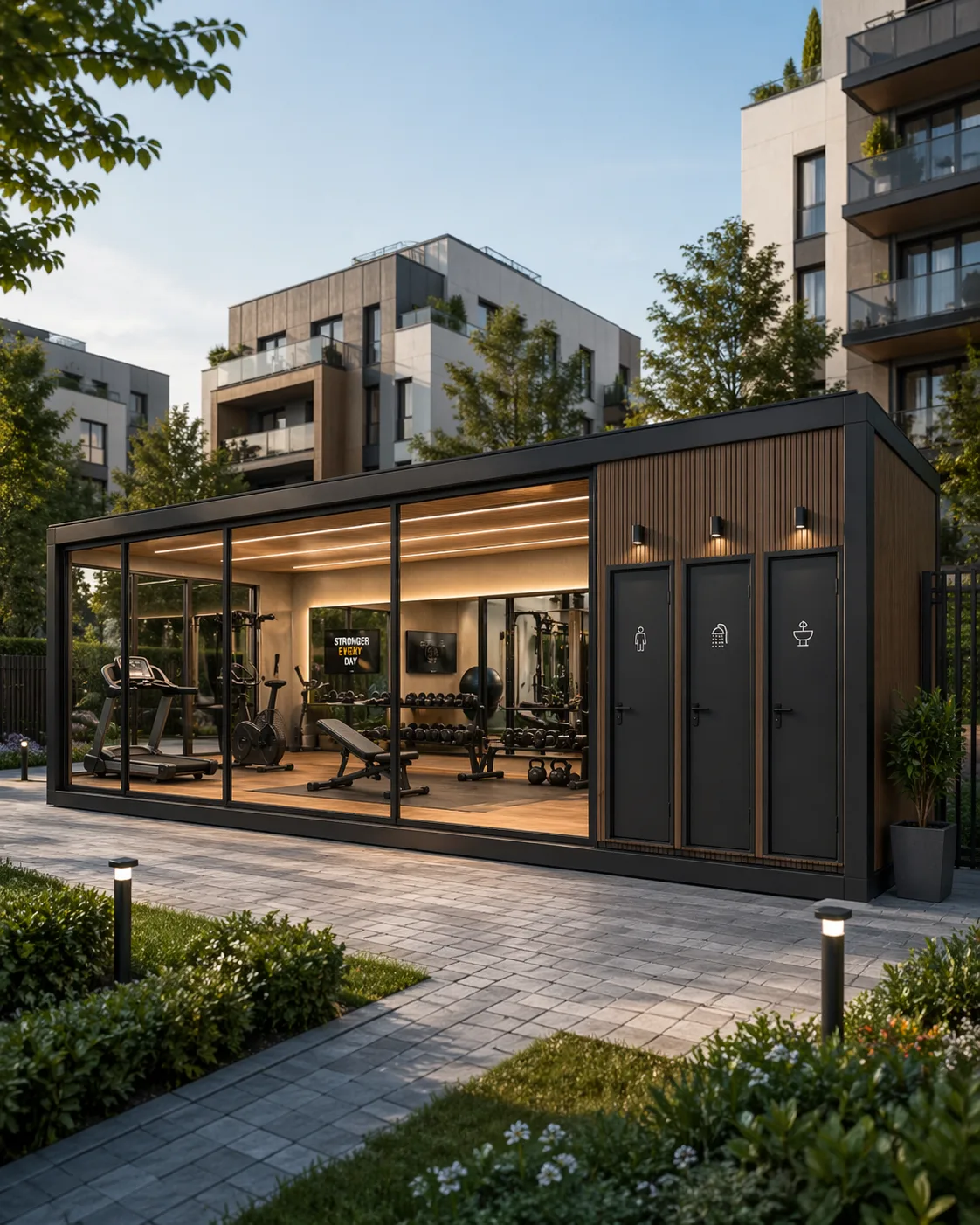
An on-site gym is no longer a luxury. For UK buyers and renters it has become an expected amenity — alongside secure cycle storage, EV charging and good landscaping. Developers and managing agents who grasp this get ahead of the curve. Those who ignore it lose viewings to the scheme down the road.
What follows is a practical guide for developers, freeholders, RTM companies and managing agents weighing up a shared gym for a residential scheme.
Why a Gym Box rather than a gym inside the building?
This is the question we hear most often. There’s a good answer.
| Criterion | Gym fitted inside the block | Gym Box in the grounds |
|---|---|---|
| Build cost | £45,000–130,000 (fit-out of an internal unit) | from £13,000–25,000 |
| Lead time | 6–18 months | 10–14 weeks |
| Noise for residents | High (vibration through the slab) | Isolated, no complaints |
| Land requirement | Needs a free ground-floor unit | Spare amenity land on the plot |
| Future expansion | Difficult and costly | Add a second module |
Where you have spare amenity land, a Gym Box is the faster, cheaper and logistically simpler option — and it keeps lettable or saleable internal floor area for what actually generates revenue.
Who is this for?
➜ Developers — a gym as a headline amenity on a new scheme, ready before first completions ➜ Freeholders and RTM companies — retrofitting an amenity to an existing block from the reserve fund ➜ Managing agents — a tenant benefit that reduces churn in multi-let buildings ➜ Build-to-rent operators — an amenity that lifts the rent and lowers the vacancy rate
How do leaseholders and freeholders fund it?
A block of flats can pay for a Gym Box in several ways. The right route depends on the lease and the structure — confirm it with the building’s accountant or managing agent:
➜ Reserve (sinking) fund — if the accumulated balance allows for it ➜ One-off service charge contribution — agreed at a residents’ meeting and apportioned across the units ➜ Block loan — banks will lend to an RTM or management company as a legal entity ➜ Leasing / hire purchase — less common for residential, but available where the management company is VAT-registered
The minimum number of units at which a shared Gym Box makes financial sense: 20–30 flats. On larger schemes (100+ units) it’s worth specifying two modules or a single larger custom build.
Planning and consents on a residential scheme
A Gym Box on shared amenity land is treated like any other outbuilding. The detail depends on the site, so always confirm with your local planning authority:
➜ A shared amenity building on a multi-unit scheme usually needs a planning application rather than relying on permitted development (PD rights are tighter on flats and shared land) ➜ On a new development, fold it into the wider scheme so it sits within the existing consent and any Section 106 amenity commitments ➜ Building Control approval for the foundation, electrics and means of escape ➜ Power: a spur from the main building’s supply, or a dedicated connection ➜ Access: we recommend keypad locks or a fob system from day one
We help review the consents free of charge as part of the project quote — see our planning permission guide for the residential side in more detail.
Managing access for residents
A few models we’ve set up for clients:
➜ Open 24/7 access — keypad lock with a shared code for all residents. Simple, cheap, popular. ➜ Fob / access-card system — logs entries and lets you restrict hours. System cost: from £400. ➜ App-based booking — for larger or higher-spec schemes, using the managing agent’s resident portal or an off-the-shelf booking app. ➜ Outsourced management — the managing agent handles cleaning and servicing under the existing contract.
What does a Gym Box for a development cost?
A worked example for a 50-flat scheme:
| Item | Cost |
|---|---|
| Gym Box 9×3 Standard (27 m²) with equipment | from £24,000 |
| Foundation + power connection | from £1,600–3,000 |
| Access system (fob or keypad) | from £400–700 |
| Total | approx. £26,000–27,700 |
Split across 50 flats: from £520–550 per unit. One-off.
For a developer that cost is absorbed into the sale price, and it works as a selling point worth a multiple of that figure on every completion. For an existing block it’s a modest service-charge contribution for a permanent amenity.
For comparison: an equivalent shared Gym Box in Poland runs around 85,000–110,000 zł — the unit itself ships from our Polish factory and delivery to the UK is standard, so the build cost is broadly comparable once converted.
See the 9×3 size page and the apartment-building gym page for layout options.
ROI for the developer
This is hard to pin to a clean number, because a gym influences the buying or renting decision rather than generating direct revenue.
What we see in the market:
➜ Schemes with a gym and secure cycle storage shift faster and stick less on portals ➜ Scope to lift asking prices on prestige schemes where the amenity offer is part of the pitch ➜ For build-to-rent: higher achievable rent and a lower vacancy rate where amenities are part of the package
For a numbers-led view of the rental case, our ROI calculator and the community gym page are the right starting points. You can also see a real shared build on the 9×5 community gym project.
Planning a scheme and want a Gym Box quote for the development?
Free consultation, response within 24 hours.