
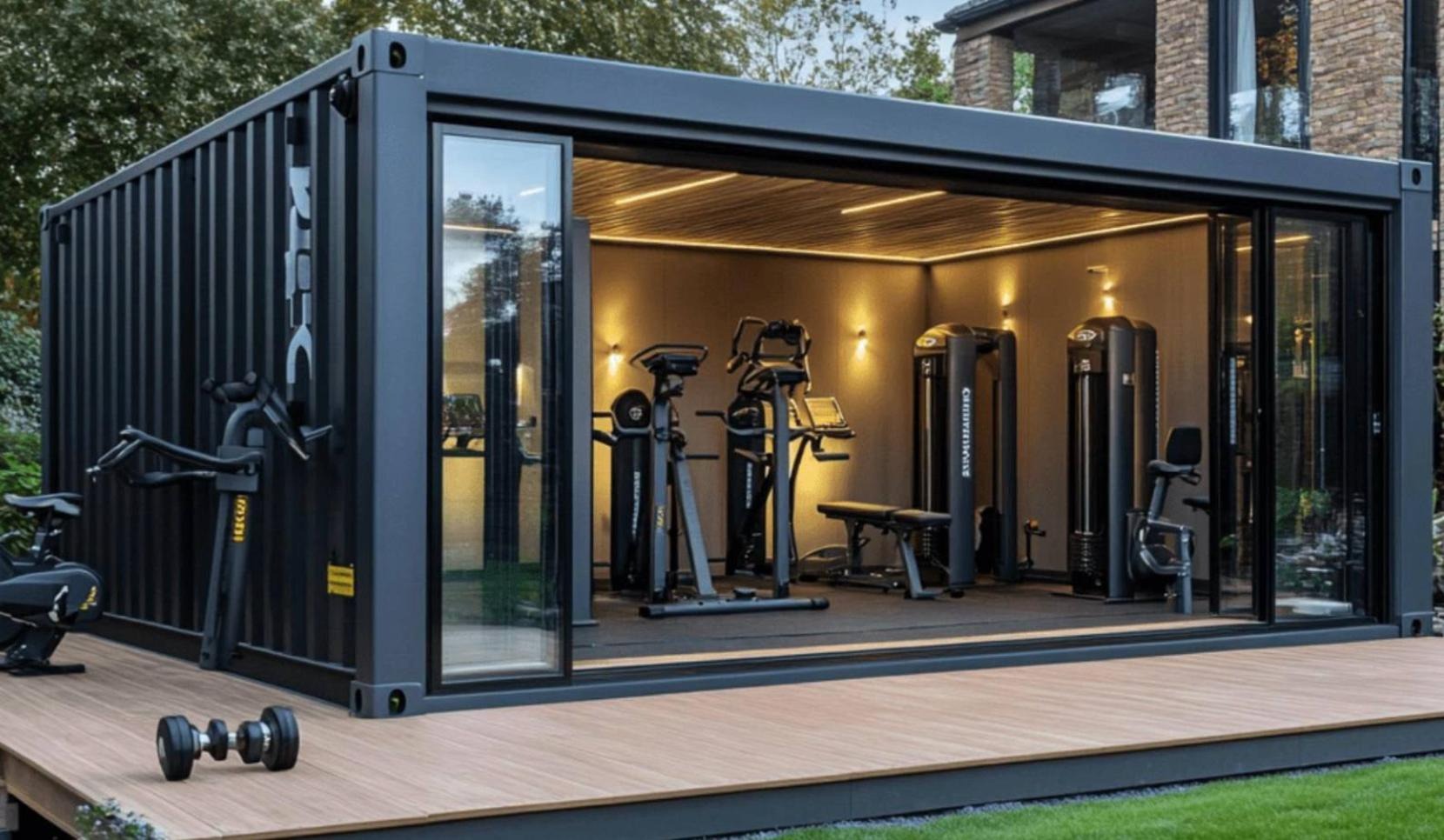
“My mate runs a container business — I’ll grab a used 20-footer for a couple of grand and convert it into a gym myself.” We hear some version of this most weeks. Six months after the build, half of those people come back asking for a quote on a “proper” Gym Box, and the other half are emailing us about cracked flooring, condensation running down the walls, and a unit they can’t insure or sign off.
From the outside, a converted shipping container and a Gym Box look similar — a rectangular steel box with a window or two. Inside, they’re two different things. Here are the tables and the hard numbers that explain why.
Construction — the difference that matters most
A standard ISO shipping container (or a basic modular cabin) is built to carry cargo or light occupancy loads — roughly 150 kg/m² of distributed weight: a sofa, a desk, two or three people. The plywood floor sits on cross-members spaced wide apart, designed to be picked up by forklift, not to absorb repeated impact.
A gym generates loads in a completely different category:
- A loaded power rack — 350–500 kg through four small feet,
- A trap-bar deadlift with a 200 kg load plus two spotters — 350 kg across 0.8 m²,
- A 100 kg barbell dropped from 1 m — an impact of around 800 kg at a point, even through rubber matting,
- A Concept2 rower with a 90 kg user — 130 kg shifting dynamically back and forth.
Under loads like these a converted container deflects 5–15 mm over six months and splits along the plywood joints.
A Gym Box has:
- A base frame in 120×120 mm steel section, reinforced with cross-members every 40 cm,
- A floor build-up: 3 mm steel plate + 22 mm marine-grade plywood + 15 mm sports matting,
- A static load rating of 500 kg/m² and impact resistance up to 1,500 kg at a point,
- Anchor points for the power rack welded into the frame at the factory.
Comparison table — Gym Box vs shipping container conversion
| Parameter | Container conversion | Gym Box |
|---|---|---|
| Base frame | 80×80 mm section / ISO corner posts | 120×120 mm section |
| Floor load rating | ~150 kg/m² | 500 kg/m² |
| Wall insulation | 60–80 mm (if any) | 120 mm PIR/PUR |
| Roof insulation | 80 mm (if any) | 150 mm PIR/PUR |
| Wall U-value | 0.38 W/m²K | 0.18 W/m²K |
| Sports floor | none (add-on) | factory, 3-layer |
| Ventilation | passive | mechanical with heat recovery |
| Air conditioning | none | factory, 3.5 kW |
| Heating | plug-in electric heater | inverter AC + supplementary element |
| Power-rack anchors | none | built into the frame |
| Corrosion warranty | none / a few months | 10 years |
| Commercial safety standard | does not meet | meets EN/ISO 20957 |
| Sign-off as a habitable/usable building | usually refused | standard documentation provided |
What does a DIY container conversion actually cost?
People price the container and stop there. The real cost of bringing it up to gym standard looks very different. Figures below are net of VAT (UK VAT is currently 20% on most of these items):
| Item | Cost (from) |
|---|---|
| Used 20 ft shipping container (good condition) | from £2,200 |
| Floor reinforcement (steel + ply + matting) | from £1,400 |
| Wall insulation (spray PUR 60 mm) | from £1,000 |
| Split AC 3.5 kW + install | from £1,100 |
| Mechanical ventilation (small heat-recovery unit) | from £1,300 |
| Larger window for daylight | from £700 |
| Wider doors to move equipment in | from £600 |
| Electrical first/second fix and consumer unit | from £900 |
| Total | from ~£9,200 |
And that is before any equipment, with no manufacturer warranty on the whole, no commercial standard, no energy certification, and a unit that depreciates badly. A Gym Box 9×3 from £24,000 incl. VAT arrives with all of that built in, plus a 10-year corrosion warranty.
➜ The maths is similar at the smaller end: a converted container plus conversion creeps towards the cost of a fully specified Gym Box 8×3 from £23,400 incl. VAT, which already includes the AC, the sports floor, the power rack and the rest.
Five things you can’t do with a converted shipping container
- Get it signed off as a gym building. A structural engineer won’t put their name to a container floor without load testing for sports use. A Gym Box ships with the documentation in the package — see planning permission for a garden gym.
- Bolt down a power rack properly. M12 anchors into thin 1 mm steel won’t hold 500 kg under dynamic load. The Gym Box has welded anchor points from the factory.
- Run it commercially. PT studios, hotel gyms and developer amenity spaces are expected to meet the EN/ISO 20957 safety standard for fixed training equipment — documentation a DIY conversion simply doesn’t have.
- Insure it on a full policy. Insurers routinely exclude DIY structural conversions from contents and buildings cover. A standard container gym insurance position is much cleaner — worth confirming with your broker.
- Finance it cleanly. Asset finance and lease providers want an invoice for a manufactured “container gym” with a manufacturer warranty. A used container plus a stack of conversion invoices is usually declined — see fitness equipment leasing.
There’s a sixth, quieter one: resale. A used Gym Box holds 50–60% of its value at year five. A self-built conversion: 15–25%.
EN/ISO 20957 — why the standard matters
EN/ISO 20957 sets out the safety requirements for stationary training equipment and the spaces around it: flooring, lighting, ventilation, clearances between machines.
For a private home gym, the standard isn’t compulsory. But for:
- a hotel gym,
- a corporate gym in a benefits package,
- a developer amenity gym in a residential scheme (developer gym),
- a personal training studio renting slots to clients,
— it’s effectively expected by your public liability insurer and any health-and-safety audit. A converted container will never satisfy it. Where the rules apply to your specific use, confirm the detail with your local authority and your insurer.
When does a container conversion make sense?
Honestly: almost never for a gym. Sensible uses for a basic container or cabin are:
- a site office on a building project,
- a tool or equipment store,
- welfare facilities on site (kitchen + WC + drying room).
If you want a gym in the garden, garage or basement and the budget is tight, a better move than converting a container is a Gym Box 6×3 Compact at the entry end of the range, or a smaller custom Gym Box — both purpose-built, both warrantied.
Summary
| What you’re after | Choose |
|---|---|
| A cheap module for a site office or store | Shipping container / cabin |
| Training 3–5× a week, at home | Gym Box 8×3 / 9×3 |
| Commercial use (PT, hotel, corporate) | Gym Box specified to EN/ISO 20957 |
| Shared amenity for a residential scheme | Gym Box 7×5 with documentation |
Converting a shipping container into a gym is a false economy. Once you’ve added insulation, floor reinforcement, ventilation and AC, you’ve spent your way towards a dedicated container gym anyway — without the warranty, without the standard, and without a unit you can sign off or insure cleanly.
Free consultation · Reply within 24 hours
We’ll tell you which Gym Box size fits your scenario — no push to over-spec it if a smaller unit does the job. ➜ Get in touch or build your quote online.