
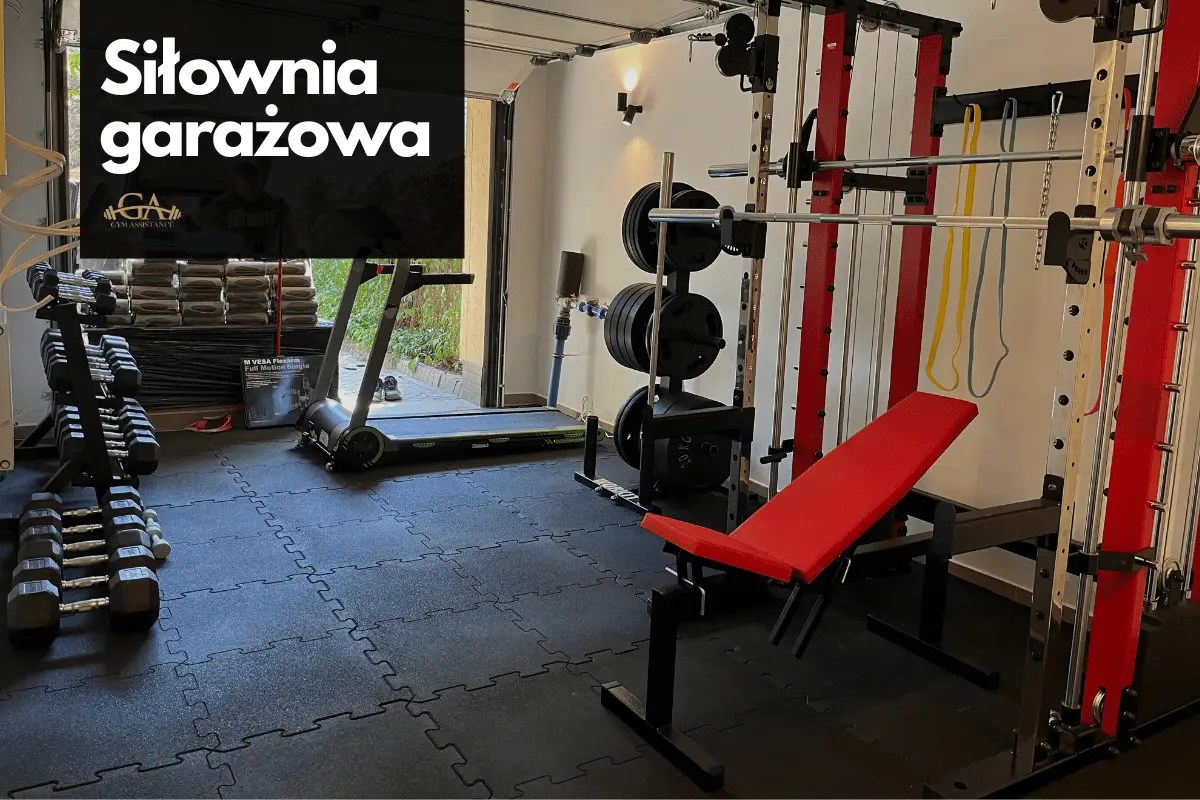
The garage sits half-empty, the car lives on the drive, and you still drive 20 minutes across town to a gym you pay £40 a month for. Sound familiar?
A garage gym is one of the most sensible options for anyone who already has the space and doesn’t want to build from scratch. But for a garage to work as a training space — and not just a cold room with some dumbbells on a concrete slab — you need to know what to adapt and what it actually costs.
A garage as a gym: the honest pros and cons
Pros:
- Separate entrance — train at 6am without waking the house
- The space is usually there: a typical UK single garage is 15–18 m², a double 30–35 m²
- No planning permission needed (as long as you don’t change the building’s use)
- You can do it in stages — equipment first, then the fit-out
Cons:
- Bare concrete with no heating — in a British winter the slab sits at single-digit temperatures
- Poor ventilation in most standard garages
- Acoustics: metal up-and-over doors and concrete reflect every sound
- Damp — especially in older garages and those built into a slope
It reads like a long list of problems. But every one of them has a specific, fairly affordable fix.
What needs adapting?
Flooring — priority number one
A bare concrete garage floor is wrong for training kit for three reasons: it chips and damages weights, it’s slippery underfoot when you’re loaded, and it bounces every clang straight through the house.
The fix: rubber matting 20–30 mm thick. For a 20 m² area you’ll want around 60 tiles at 50×50 cm. Cost: from £350 up to roughly £600 depending on thickness and brand. More on the trade-offs in our home gym flooring guide.
If the slab is uneven, lay a self-levelling compound first (from £60 in materials, plus labour).
Heating — without it, the garage works for half the year
The UK winter is milder than mainland Europe, but a single-skin concrete garage still drops below 10°C from November to March — cold enough to kill any motivation and stiffen every joint.
Quickest, cheapest fix: an electric infrared heater (from £80). It warms the space in 10–15 minutes, produces no fumes, needs no gas connection.
For a garage you intend to keep as a gym: an air-source split unit with a heat-pump heating mode (from £900 fitted). It gives you warmth in winter and cooling in summer — and at a coefficient of performance of 3–4, it heats far more cheaply than a plug-in radiant heater. It pays for itself comfortably over a few seasons.
Ventilation — the absolute minimum
Hard training in a sealed garage produces 1–1.5 kg of sweat an hour and burns through oxygen fast. No ventilation means a stuffy room, quicker fatigue and damp that corrodes your kit.
Minimum: a wall-mounted extractor fan (from £50). Long term: mechanical ventilation with heat recovery (MVHR), but that’s a job of its own — from £600 for a single-room unit.
Lighting — the bit everyone forgets
A standard garage has one bulb by the door. For training you want even, shadow-free light — it matters for form when you’re under free weights.
LED battens at 4000K (neutral white), 40–60 W per 10 m². A full set for a 20 m² garage: from £60 up to around £160. Even light, no dark corners over the squat rack.
Insulation — optional, but worth the thought
An uninsulated garage burns roughly 3× the energy to heat. 50–100 mm of insulation board on walls and ceiling plus a vapour barrier: from £400 in materials (labour usually doubles that). The single biggest weak point is the up-and-over door — an insulated roller door or a foam-panel kit closes the worst gap. If you plan to train here for years, the maths works.
The cost in three tiers
Tier 1 — Starter: from £1,400
For someone who wants to start training in the garage without a big outlay. Basic kit, minimal fit-out.
| Item | Indicative cost |
|---|---|
| Rubber matting 15 m² | from £250 |
| Infrared heater | from £80 |
| Extractor fan | from £50 |
| LED lighting | from £60 |
| Multi-function rack | from £450 |
| Olympic bar + 80 kg plates | from £300 |
| Adjustable bench | from £120 |
| Total | from £1,400 |
That’s already a complete setup for basic strength training.
Tier 2 — Comfort: from £3,000
Full space fit-out plus equipment with no compromises.
| Item | Indicative cost |
|---|---|
| Rubber matting 20 m² (30 mm) | from £400 |
| Air-source split unit | from £900 |
| Mechanical ventilation | from £350 |
| LED lighting (full set) | from £120 |
| Wall mirrors 2 m² | from £150 |
| Power rack with cable pulley | from £1,000 |
| Full free-weight set | from £550 |
| Bench + accessories | from £350 |
| Total | from £3,300 |
Tier 3 — Premium: from £6,000
A private studio that outclasses most commercial gyms.
| Item | Indicative cost |
|---|---|
| Insulation + wall finish | from £1,000 |
| Sports flooring + levelling | from £700 |
| HVAC (heating + ventilation) | from £1,300 |
| LED lighting + audio system | from £350 |
| Commercial-grade rack | from £2,200 |
| Premium free weights | from £1,100 |
| Treadmill | from £900 |
| Design + installation | from £700 |
| Total | from £8,200 |
For a wider breakdown of what a complete private gym costs in different configurations, see our container gym cost guide for the UK.
Sample equipment for a 20–30 m² garage
A garage of this size easily takes:
- A multi-function rack or power rack with a cable pulley
- A full free-weight set (Olympic bar, plates to 120 kg, dumbbells 2–32 kg)
- An FID adjustable bench
- A rower or stationary bike (cardio with no outdoor noise)
- A stretching mat / kettlebells
That’s everything you need for strength, conditioning and recovery work. We go through choosing kit for specific goals in detail in the best home gym equipment.
What about the rules? Do you need planning permission?
Simply putting equipment into an existing garage needs no formalities — the garage is already a building and you can use it for its intended purpose.
The picture changes if you:
- Extend the garage — add floor area or build over it ➜ this typically needs planning permission or has to fall within permitted development
- Change the building’s use in the records (for example to a business use) ➜ that’s a change-of-use question, and business rates may follow
For the vast majority of cases — adapting an existing garage for your own use — nothing formal is required. If you’re unsure, a quick check with your local planning authority settles it. We cover the wider permission question in garden gym planning permission in the UK.
When a garage isn’t enough
A garage has one limitation: it’s fixed. You can’t move it, you can’t extend it past a certain point, and you can’t reshape it as your needs change. If the garage is also damp, north-facing or simply too small, the fit-out spend can creep close to the cost of a purpose-built unit.
If you’d rather we did it for you — proper floor under the weights, heating, ventilation and equipment chosen around your goals — see what a turn-key garage gym conversion looks like (from £5,800). We’ll also help with equipment selection matched to your goals and space. And if the garage truly won’t cut it, a freestanding garden Gym Box sidesteps the damp and insulation problems entirely.
For a real example, our garage gym conversion in Bielany turned an 18 m² single garage into a year-round training space — same approach we use for UK deliveries.
Want a design for your garage?
Tell us about the space and your training goals — we’ll prepare a 3D design with an equipment proposal and a costed quote. Free, no obligation, and we reply within 24 hours.
➜ Get in touch with Gym Assistance ➜ Request a quote
Related articles: