
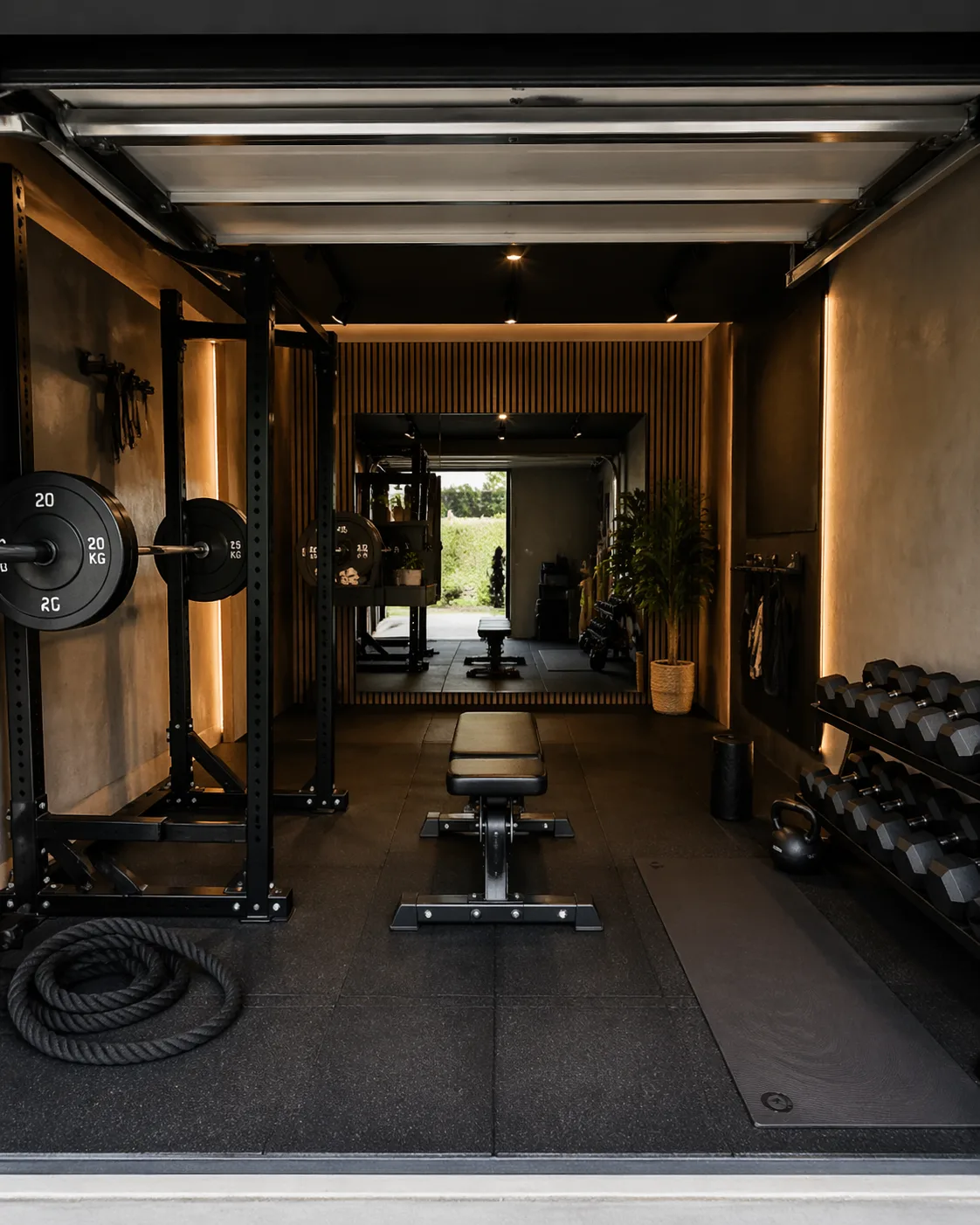
The client and the space
Anna lives in a terraced house in Bielany (a residential district of Warsaw) with a double garage and one car. The second bay had been standing practically empty for years — the usual accumulation of things nobody needs but nobody throws away. A classic situation that will be instantly recognisable to anyone who’s looked at their spare garage space and thought: there must be a better use for this.
After the first consultation it became clear we had exactly 18 m² to work with (6 × 3 m), low entry doors, and one significant structural constraint: the garage ceiling height was just 2.2 m in the clear. That’s 30–50 cm lower than a typical basement or standalone outbuilding.
The challenge: low headroom
2.2 m is the lower boundary of comfort for a gym. A standard power rack with a pull-up bar and a 185 cm user? Not a chance — the bar would clear the ceiling by centimetres, but safely getting your chin above it while hanging freely is simply impossible.
We solved it two ways:
1. Compact rack — we specified a model with a maximum height of 200 cm rather than the standard 213–230 cm. This rack is purpose-built for lower rooms, with modified safety arm geometry, and covers every standing and seated barbell exercise without compromise.
2. TRX instead of a fixed pull-up bar — rather than a bar bolted to the ceiling, we installed a beam-mount anchor point with TRX suspension straps. Suspension training delivers equivalent pulling-pattern work to pull-ups, and Anna — as she puts it herself — uses the TRX at every single session.
This low-ceiling solution translates directly to the UK context: many UK double garages have similar or even lower clear heights, especially in older terraced and semi-detached properties.
Garage adaptation works
The garage needed no major structural work — that’s its biggest advantage over a basement conversion or loft build. What we did:
➜ Pressure washing and priming the concrete floor — clean and dry before any matting goes down ➜ 20 mm rubber interlocking mats — covering 16 m² (the training area, leaving a transition strip by the door) ➜ Additional electrical circuit — the garage had a single 230V socket. We ran a dedicated 16A circuit with four sockets plus USB points ➜ Flush-mount LED panels — ceiling-mounted flat to the surface, losing zero headroom. Delivers 400 lux across the full room ➜ 1500W electric panel heater with thermostat — sufficient for a well-insulated garage
Equipment
At 18 m², every centimetre counts. We selected multi-functional equipment with minimal floor footprints.
➜ Body-Solid EXM4000S compact rack — full-function in a small frame: high and low cable, moving arms, pull-up bar lowered to 195 cm. Enables dozens of exercises without requiring anything additional ➜ Dumbbells 2–40 kg — rubber hex set, 2 kg increments to 30 kg then 5 kg increments above. Two-tier rack, 90 cm wide, against the left wall — doesn’t block movement through the space ➜ Adjustable folding bench — 0°/30°/45°/60°/90° positions. Folded and stood upright it takes 30 cm of wall space ➜ TRX system — beam anchor, two complete strap sets. Hung close to the ceiling, they don’t interfere with floor or barbell exercises ➜ Exercise mats — two 180 × 60 cm EVA roll mats for stretching and core work ➜ Mirror 2 × 1.5 m — on the front wall. In a tight space, a mirror does double duty: technique monitoring and making the room feel significantly larger
Timeline
2 weeks — the shortest build in our portfolio. Adaptation works took one day; the rest was equipment delivery and installation.
The financial case
£5,000 for a garage gym is one of the best investments you can make as a regular trainer. A quick comparison:
| Option | Monthly cost | Cost after 5 years |
|---|---|---|
| Gym membership | approx. £50 | £3,000 |
| Garage gym | £0 (after year 1) | £5,000 |
At four sessions a week, you break even somewhere around year eight to nine. But that calculation ignores the time saving — at 20 minutes each way and four sessions a week, that’s over 110 hours a year you’re not spending on the commute to a gym.
And it ignores the fact that you’ll actually train more consistently when the gym is ten metres from your back door.