
Residents want a gym. Estates that have one sell better.
The residential market has matured. People buying a flat now compare more than the price per m² — they compare amenities. An on-site gym is today as much of a selling argument as a parking space.
But not every association has a room in the building that can be converted into a gym. GymBox solves that — we install a free-standing module on association land, without touching the building structure.
Why a GymBox rather than a converted room?
| Criterion | GymBox (module) | Room in the building |
|---|---|---|
| No available room | ✔ not needed | A problem |
| Conversion | None — ready-made | 3–12 months of works |
| Noise transfer | Insulated module | Transmits vibration |
| Cost | from ~£39,100 | £28,000–£75,000 |
| Relocatable | Yes | No |
| Year-round | ✔ polyurethane insulation | Depends on building heating |
What does a community gym look like?
Basic variant — residents-only gym
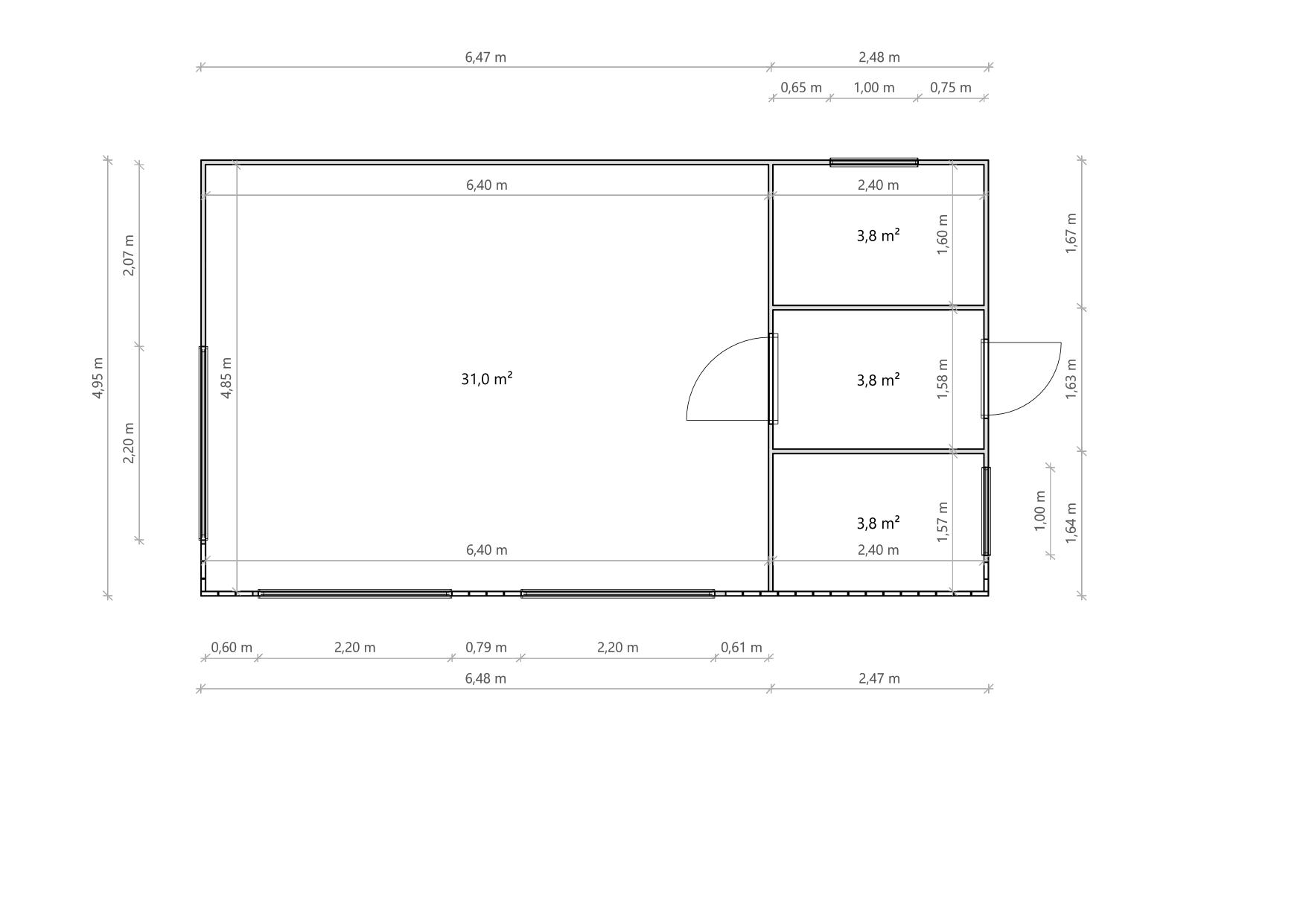
A 6×4 m or 8×3 m module, access for residents only (card, app or PIN). Self-service equipment without on-site staff.
➜ Multi-station cable machine ➜ Dumbbells, free weights ➜ Bike and treadmill ➜ Mirrors, AC, LED
With facilities — larger estates
9×5 m or 10×4 m module with separate WC and changing room. Optional payment system — memberships for residents or open model for the neighbourhood.
Access system
➜ Smart lock (Tedee or equivalent) ➜ Access via app or QR code ➜ Entry log — administrator sees who came in and when ➜ IP monitoring
Funding model for an association
The investment can be staged or funded from various sources:
➜ Reserve fund — vote at the AGM and one-off payment ➜ Association loan — instalments over 3–5 years ➜ Revenue model — resident memberships cover the cost (payback in 6–10 years) ➜ Grants — some local or European programmes support sports infrastructure
Example economics for 80 flats
| Item | Value |
|---|---|
| Investment cost | ~£42,000 |
| Resident membership | ~£12/month |
| 30-member uptake | ~£360/month |
| Operating cost (electricity, service) | ~£80/month |
| Payback | ~12 years (without association top-up) |
With association funding or reserve-fund support, payback drops to 6–8 years.
What lifts property value on an estate?
UK and European secondary-market data shows that flats in developments with sport and leisure infrastructure command a 2–5% premium over comparable properties without it.
On a £200,000 flat, that’s £4,000–£10,000 extra. For the owner — a real gain at no cost to them personally.
What does the process look like?
- Free consultation — we assess the site, suggest size and layout
- Association vote — we help prepare materials for the meeting
- Design and visualisation — we show how the module will look on your land
- Production, delivery and installation — the Gym Box is ready 12 weeks from the deposit (delivery quoted by postcode, installation included)
- Commissioning — access-system configuration, manager handover
FAQ
Can the module be installed without unanimous owner consent? The decision rests with the association — typically a simple majority (over 50% of shares) in a vote is enough. We help prepare materials for the meeting.
Who manages the gym after installation? The association manager or a nominated person. With the unmanned system, duties are limited to a monthly inspection and electricity-bill reconciliation.
Is the module safe for children? The access system limits entry to registered users. We recommend an age limit of 16+ and a usage policy.
Want to know more? Free consultation for housing associations →
More: Developer gym → | Case studies →