
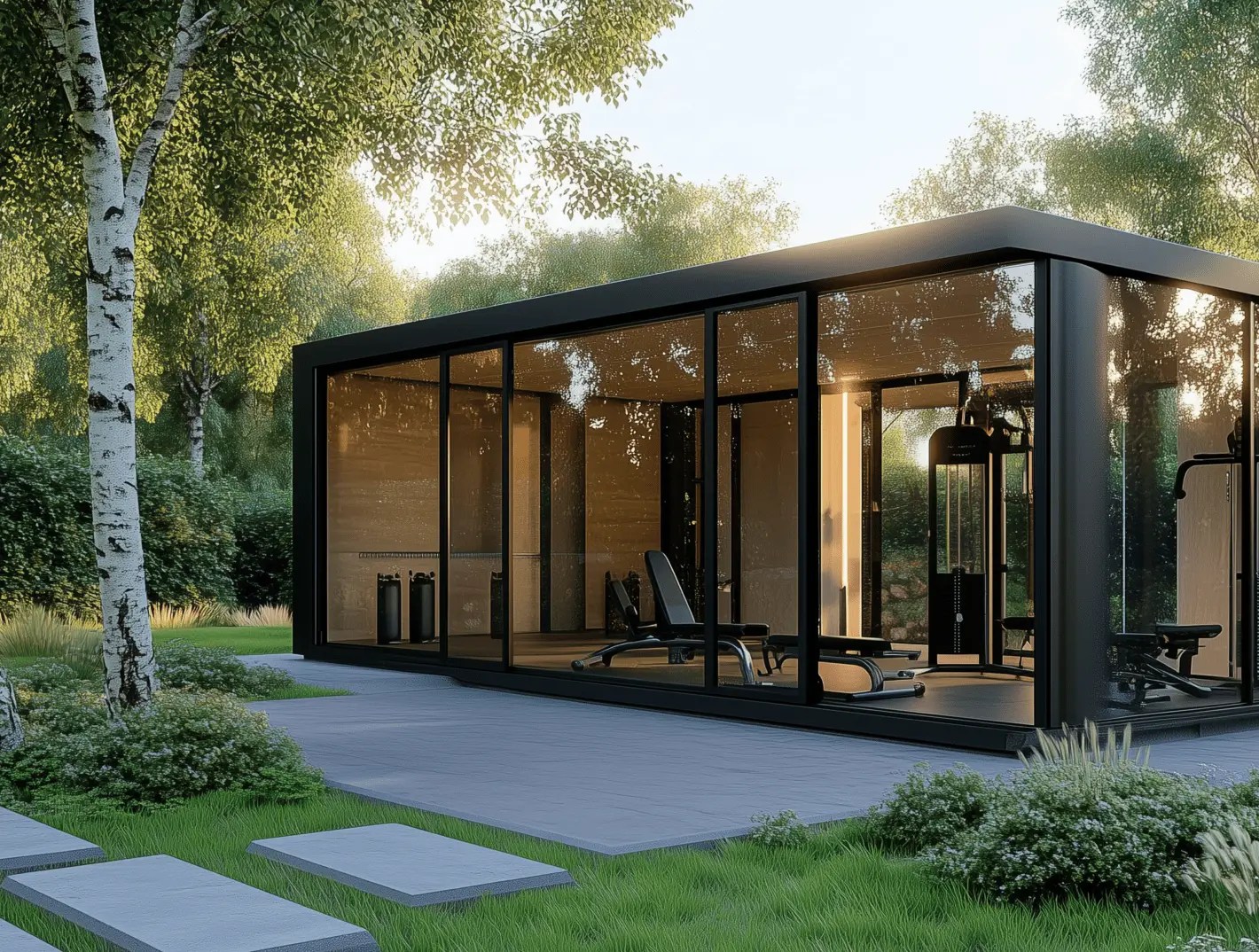
The most common worry: “What about winter?”
Clients asking about Gym Box almost always raise this first or second. Rightly so — winter comfort is one of the key arguments for a container gym, not against it.
Short answer: yes, Gym Box runs year-round. Even at −20°C.
How is Gym Box heating built?
The container walls have 120 mm of mineral insulation — the standard used in modern passive building. For comparison: a typical brick garage wall has 0 mm of insulation.
Our standard container spec:
- Wall insulation: 120 mm mineral wool
- Roof insulation: 120–150 mm
- Floor: 60 mm polystyrene + load-bearing layer
- Windows: double-glazed, warm-edge spacer
- Doors: insulated, perimeter seal
For heating we use one of two solutions (your choice):
Option 1 — Electric heater with thermostat
Simple, cheap to install (£100–300), controlled via smartphone or timer. Before training you switch it on 30 minutes ahead — you walk into 18°C.
Running cost at −10°C outside and 18°C target inside: ~£0.50–0.75 per hour of heater operation in a properly insulated module.
Option 2 — Heat pump / split air conditioning
More expensive to install (£600–1,200), but ~3× cheaper to run. Cools in summer, heats in winter. With a proper COP of 3.0 — for every £1 of electricity you get £3 of heat.
We recommend a split unit when the client plans to train regularly all year round.
How much does electricity cost in winter?
Assumptions:
- Gym Box 8×3 (24 m²)
- 120 mm insulation
- External temperature: −5°C (typical UK winter cold snap)
- Internal temperature: 16–18°C
- 2000W heater with thermostat
Real consumption: ~3–5 kWh per training session (1.5 h workout + 30 min warm-up).
At a UK electricity price of £0.27/kWh: **£1–1.50 per session.** Monthly, at 3 sessions per week: ~£15–20 / month.
For comparison: a monthly chain-gym membership is £25–60.
Practical winter tips
Before the season:
- Check door and window seals (one draught = 30% more electricity)
- Fit a thermometer inside — you check temperature remotely
- If you have a split: don’t switch off completely on freezing days, set minimum mode (10°C) — reheating from 0°C burns more energy
During training:
- Don’t ventilate the container between sets — leaving the window ajar for the last 10 minutes is enough
- Dumbbells and barbell can be cold in deep frost — deadlift gloves double as initial warm-up
- Rubber matting holds heat better than a cold concrete floor
After training:
- Drop the temperature to 12°C (“hold” mode) — saves energy, prevents damp
- Leave the door open for 5–10 minutes to vent sweat humidity
What about summer?
Split air conditioning works both ways. In July at 35°C outside, a container cooled to 22°C is a luxury that isn’t possible in a garage without AC.
An electric heater simply switches off in summer — uses nothing.
Summary
| Question | Answer |
|---|---|
| Is Gym Box year-round? | Yes |
| How much does heating cost? | £15–25 / month in winter |
| How long to heat to 18°C? | 20–40 minutes from cold, 5 minutes if held at 12°C |
| Does frost damage the equipment? | No, with proper heating |
| Recommended heating system? | Split (heat pump) — more efficient and quieter |
Got questions about a specific configuration? Ask us — we’ll match the heating to your climate and training habits. We deliver to UK, Ireland and DACH — winter spec adjusted to local climate norms.