
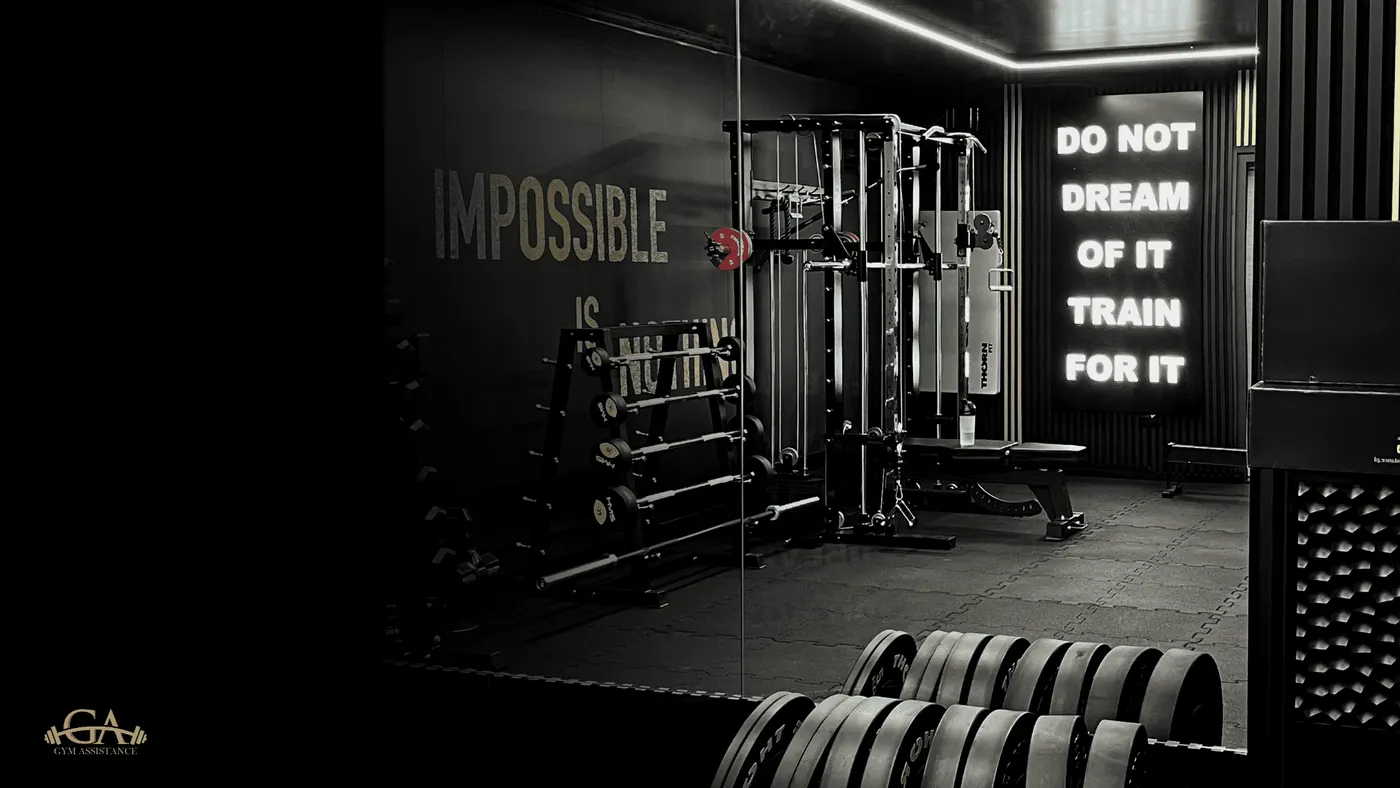
Training through a 30°C heatwave is a different sport. A properly built Gym Box holds its temperature through a British winter on insulation and a small heater — but in July, with sun on the steel and two people working hard, you want active cooling. It’s the single most frequent topic in our spring and summer calls.
Below: what to specify, how to install it, and what it actually costs to run.
The summer problem: insulation works both ways
A Gym Box has 120 mm of mineral-wool insulation in the walls and ceiling. In winter that’s pure benefit — heat stays inside. In summer the sun heats up the outer steel skin and the same insulation slows the heat escaping back out. Without active cooling, with 25–28°C outside and a hard session inside, the interior temperature can climb to 32–36°C — uncomfortable, and beyond the point where heart rate becomes unreliable as a training signal.
That’s not negotiable. Air conditioning in a UK container gym isn’t a luxury — it’s the difference between “trains year-round” and “trains nine months a year and the unit becomes a shed in summer”.
Option 1: Split AC system — the right answer
The default in every premium build we deliver in the UK.
➜ Indoor unit mounted high on the long wall or under the ceiling
➜ Outdoor condenser unit at the back of the Gym Box or on a wall bracket
➜ Refrigerant lines run through a sealed wall penetration — we cut this at the factory, not on site
How much capacity?
| Gym Box floor area | Recommended capacity | Typical specs |
|---|---|---|
| Up to 24 m² (8×3) | 2.5–3.5 kW (~9,000–12,000 BTU/h) | Daikin Sensira, Mitsubishi MSZ-AP |
| 24–30 m² (9×3) | 3.5–5.0 kW (12,000–18,000 BTU/h) | 3.5 kW with headroom |
| 30–35 m² (6×5 or 7×5) | 5.0–6.0 kW (18,000–21,000 BTU/h) | One 5.0 kW unit, or two 2.5 kW |
Don’t undersize. Two people in a hard session add ~400–600 W of body heat alone, plus equipment and lighting. Spec the unit with 20–30% headroom against the room calculation.
Costs (2026, UK)
| Item | Cost |
|---|---|
| Split AC 3.5 kW (Daikin Sensira or equivalent) | £700–1,200 |
| F-Gas certified installation | £400–700 |
| Wall penetration in the module | £0 (factory-cut to your spec) |
Running cost: a 3.5 kW unit with an SEER of ~7.0 draws roughly 1 kWh of electricity per 3.5–4 kWh of cooling delivered. At 1.5 h of training per day across 90 summer days, that’s ~70–90 kWh — about £20–28 per summer at 28p/kWh. Cheaper than a single chain gym membership for the season.
Option 2: Mechanical Ventilation with Heat Recovery (MVHR)
Strong as a complement, not strong enough on its own in summer.
An MVHR unit recovers up to 85% of the warmth from outgoing stale air in winter, and provides constant filtered air exchange. Benefits:
➜ Fresh air without opening doors — solves the CO₂ build-up and condensation during hard sessions
➜ Pollen and particulate filtering — useful if you train near a busy road or have hay fever
➜ Heat recovery in winter — meaningful saving on heating cost
Cost: £800–1,800 for a small residential unit (Vent-Axia, Aereco, Mitsubishi Lossnay) plus £400–700 to install. In a standard Gym Box we fit passive trickle vents and rely on the AC’s air movement; MVHR is a premium option for clients training daily or planning long sessions.
Option 3: Portable AC — strongly discourage
We know it looks tempting as a starter solution. The reality:
➜ Portable units run 30–50% less efficient than a comparable split
➜ The hot exhaust duct has to vent through a window or wall — which means leaving a hole in your insulated, sealed module
➜ Louder than a split, sometimes by 5–10 dB
➜ After 2–3 summers you’ll buy a split anyway
The only honest use case: a one-summer stopgap on a really tight budget.
Heating in winter — what comes as standard?
Every Gym Box ships with an electric panel heater on a programmable thermostat as standard. That holds the space comfortably down to about −5°C with a 15–20 minute warm-up. Below that, or if you want to walk into an already-warm room:
➜ Specify a split AC with reverse-cycle heat pump mode — a 3.5 kW heat pump is dramatically more efficient than a resistive heater (COP of 3.5–4.0 vs 1.0)
➜ Add a Wi-Fi controller (Cielo Breez, Sensibo, or the manufacturer’s app) — fire up the heating from your phone 20 minutes before you walk down to the garden
Read more about the cold months: Container Gym Winter Use — Does It Really Work Year-Round?
What we prep at the factory
Every Gym Box leaves us with:
➜ Pre-cut wall or ceiling penetration for the AC line set, sealed with a removable cover
➜ Dedicated 230V/13A radial circuit to the AC location
➜ Passive trickle vents for baseline air exchange
You can buy and install the AC yourself after delivery, or order it with the Gym Box and we’ll commission the whole thing with F-Gas paperwork.
Quick summary
➜ You want comfortable year-round training? → Reverse-cycle split system. One unit does both jobs.
➜ You care about air quality and train hard? → Split AC + MVHR. The full premium spec.
➜ Tight budget? → Cheapest A-rated split you can find — and revisit MVHR in 2–3 years.
The non-negotiable is the split. Skip the portable. Skip the “let’s see how it goes”. Spec the AC at the factory stage and we’ll deliver it pre-wired.
Free consultation · Response within 1 working day
Questions about a specific layout, capacity calculation or a quiet-spec unit (under 20 dB indoor for a basement-adjacent install)? We’ll match the right unit to your project — at no cost.
➜ Get in touch with Gym Assistance
➜ See Gym Box models with AC options