
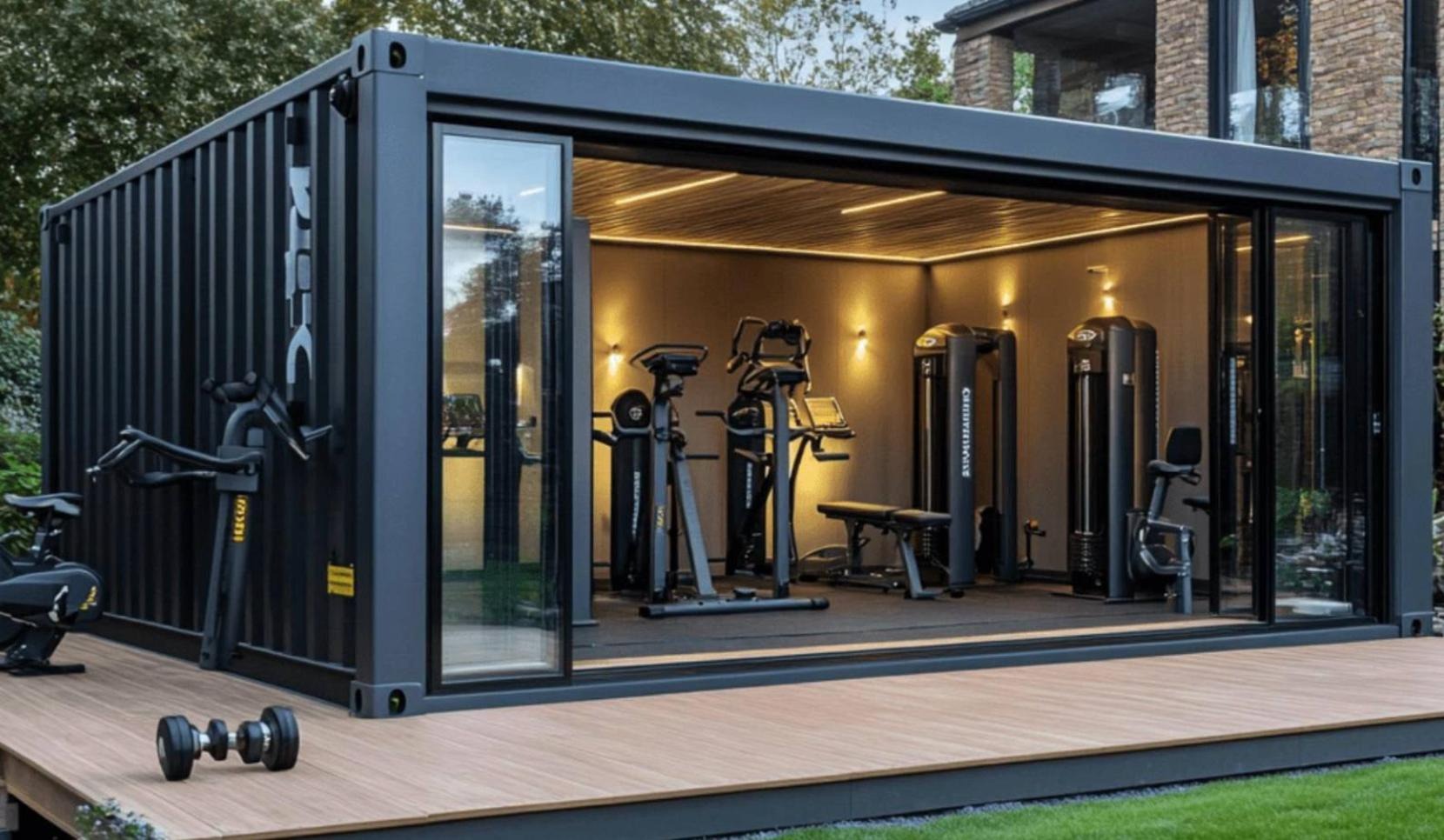
A gym with no staff. Open at 3am. It handles its own access, takes its own payments, manages its own memberships. It sounds futuristic — but across the UK it’s already a working model, with commuter-town operators turning single modules into self-funding micro-gyms that run on minimal overheads.
A Gym Box as the shell for an unmanned gym is one of the fastest-growing segments in our project book. Below is the full guide — from concept to your first paying member.
What is an unmanned gym?
The model is simple: a member registers through an app or website, buys access (monthly, weekly or a single visit), receives a unique PIN or QR code, and lets themselves in. No receptionist, no instructor, no fixed opening hours.
➜ Open 24/7 — members train whenever they want ➜ Running cost: electricity + internet + servicing + depreciation ➜ Revenue: memberships and pay-as-you-go visits
The model works best where traditional gyms are thin on the ground — commuter towns, suburban estates, market towns, and new-build developments without their own facilities.
Three business models
Model 1: Residents’ / community gym
Built for the residents of a specific development or apartment block. Access on a monthly membership (typically from £12 to £25 per resident).
➜ Target: 20–60 active members ➜ Monthly revenue: from £450 to £1,400 ➜ Owner: a property developer, a management company or a private investor
This is the easiest model to fill, because the demand is captive — see our note on a container gym for residential developments.
Model 2: Open commercial gym
Open to the public — via app, website or kiosk. Pay-as-you-go (from £4 to £7 per visit) or a standard membership.
➜ Location: retail park, business-park car park, edge-of-town plot ➜ Target: 30–100+ active members ➜ Revenue: from £1,000 a month with decent footfall
Model 3: Rollout / network model
A repeatable template — one owner, many sites in different locations. Each unit generates passive income, all managed centrally from one dashboard.
➜ Cost to open one site: from £40,000 net ➜ Scalable: 5–20 units under a single operator ➜ Franchise potential
The access system — what you actually need
The heart of an unmanned gym is the access system. It has three parts.
1. Smart lock / access controller
| Type | Examples | Cost |
|---|---|---|
| PIN-code lock | Nuki, Tedee | from £150 |
| Card / app lock | Salto KS, Roger | from £400 |
| Turnstile gate | commercial systems | from £1,200 |
For smaller sites (up to 50 members) a Tedee or similar lock with API integration is plenty.
2. Management software
You need a platform that: ➜ Takes online payments (Stripe, GoCardless) ➜ Generates a unique PIN/QR for every member ➜ Manages subscriptions and one-off visits ➜ Automatically revokes access when a membership lapses
Popular off-the-shelf options: Glofox, TeamUp, Ashbourne, Mindbody — or a custom API build (pricier, more flexible). Budget from £400 to £1,600 a year for software.
3. CCTV
➜ Camera at the entrance (essential — and your insurer will ask) ➜ 1–2 cameras inside (optional but recommended) ➜ Cloud recording, viewable from your phone ➜ System cost: from £350
For the full operational checklist — locks, ventilation timers, lone-worker and insurance basics — see our companion guide to running a self-service container gym.
Gym Box spec for the unmanned model
A standard Gym Box needs a handful of changes versus the private version:
| Element | Private spec | Unmanned commercial |
|---|---|---|
| Lock | standard | smart (API) |
| Power | single-phase | three-phase, or single-phase with sub-meter |
| Ventilation | passive | mechanical (fresh air, no odour build-up) |
| WC / changing | optional | recommended (above ~30 members) |
| Safety signage | no | yes (extinguisher, first-aid kit, fire exit) |
| Internet | home Wi-Fi | dedicated router + 4G SIM backup |
| Heating | manual | automatic (Wi-Fi/GSM thermostat) |
The 9×3 Gym Box is the most common starting point — see the Gym Box 9×3 size page for layout and capacity. For sites that need showers and a WC, step up to a larger module or a custom Gym Box.
What does it cost to launch an unmanned gym?
Prices below are net and exclude VAT (standard rate 20%). Many operators run the build through a limited company and claim capital allowances on the equipment — confirm the treatment with your accountant.
Entry build (up to 30 members, no changing room)
| Item | Cost |
|---|---|
| Gym Box 9×3 Standard, fitted out | from £24,000 |
| Training equipment | from £5,000 |
| Smart access system | from £400 |
| CCTV | from £400 |
| Base + utility connection | from £2,000 |
| Software (year 1) | from £400 |
| Total | from £32,000 |
Premium build (larger module with changing room, up to 60 members)
| Item | Cost |
|---|---|
| Larger Gym Box with WC/shower | from £26,000 |
| Training equipment | from £8,000 |
| Access system + CCTV | from £1,200 |
| Base + connections | from £3,000 |
| Software (year 1) | from £600 |
| Total | from £39,000 |
For comparison, a fully fitted entry build lands under the cost of a single year’s rent on a conventional high-street unit in most UK towns — and you own the asset.
When does it pay back?
For an entry build at an all-in cost of around £28,000:
| Scenario | Members | Revenue / month | Costs / month | Net profit | Payback |
|---|---|---|---|---|---|
| Cautious | 30 × £16 | £480 | from £160 (power + software) | £320 | ~7 years |
| Realistic | 50 × £18 | £900 | from £180 | £720 | ~3.5 years |
| Strong | 80 × £20 | £1,600 | from £240 | £1,360 | ~1.8 years |
The decisive factors are location and launch marketing. Unmanned gyms next to estates of 500+ homes typically hit full membership within 3–6 months. Run the numbers for your own site with our ROI calculator.
Formalities for a commercial gym
The detail here depends on the site and your structure, so treat this as a checklist rather than legal advice — confirm specifics with your accountant and local planning authority.
➜ A registered business (sole trader or limited company, Companies House) ➜ Planning permission, or permitted-development sign-off, depending on size and siting ➜ Public liability insurance (and CCTV/lone-user clauses your insurer requires) ➜ A GDPR-compliant privacy policy for members and CCTV ➜ Business rates and a chat with your accountant on capital allowances (AIA)
A Gym Box arrives factory-built and craned into place, so the on-site footprint of works is small — which often simplifies the planning conversation. See our overview of planning permission for a garden or container gym.
Planning an unmanned gym? We’ll help you design the module for this exact model.
➜ Get a free consultation — reply within 24h ➜ Build your quote in the configurator