
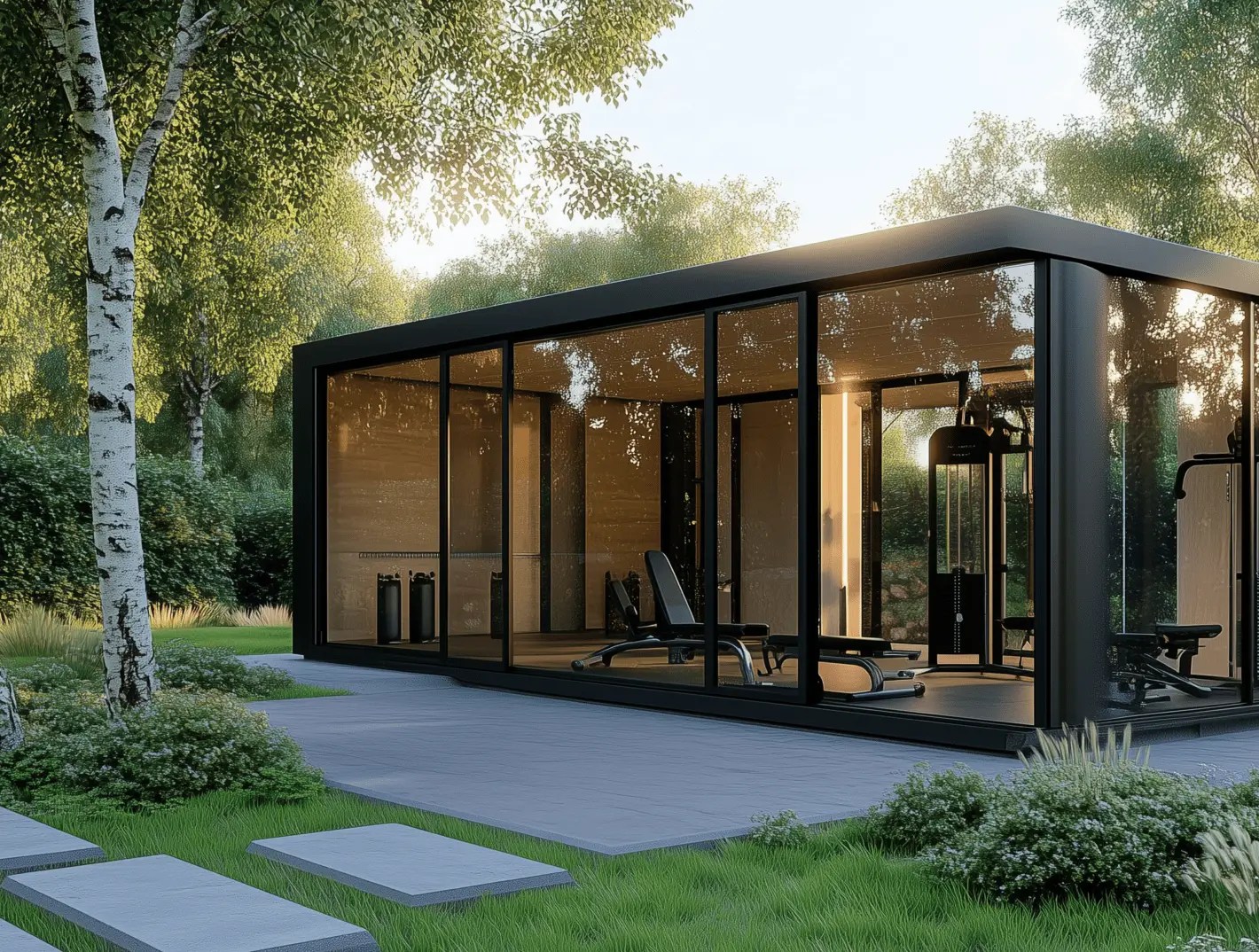
A Gym Box draws electricity. Electric heating, AC, lighting, chargers — under heavy use that’s 800–2,000 kWh per year. At UK electricity prices of ~28p/kWh: £225–560 per year for the unit on its own.
Solar PV on the Gym Box roof can cover most of that draw. The honest question: is a container roof a good platform for solar panels?
Gym Box roof specs — what matters for PV?
The Gym Box has a single-pitch roof (occasionally double-pitch). Key parameters:
| Parameter | Value |
|---|---|
| Roof load rating | 150–200 kg/m² (sandwich-panel roof) |
| Single-pitch slope | 3–8° (near-flat) |
| Roof colour | RAL 9006 / 7016 (grey or anthracite) |
| Roof area, Gym Box 8×3 | ~24 m² |
| Roof area, Gym Box 7×5 | ~33 m² |
Roof load — enough?
A 400 Wp panel weighs ~20–22 kg. On a 24 m² roof you can fit 8–10 panels = 160–220 kg. That sits comfortably within the roof rating, assuming an even load distribution.
Important: the mounting frame has to be engineered for the Gym Box. Off-the-shelf domestic-roof mounting systems are not directly compatible — you need a frame designed for sandwich-panel roofing.
Slope — a problem?
3–8° is close to flat. Optimal slope for PV in the UK is 30–40° (south-facing). At 5° tilt, output is ~12–18% below optimum across the year — less penalty than you’d expect because the UK gets a lot of diffuse light.
Solution: an angled frame raising panels to 20–30° — available, but increases wind load and costs more than a flush mount.
How much power will PV generate on a Gym Box?
Assume 8 × 400 Wp panels (= 3.2 kWp) on a Gym Box 8×3 roof, angled to 20° south-facing:
| Metric | Value |
|---|---|
| UK irradiance (annual yield) | 900–1,050 kWh/kWp/year |
| At 3.2 kWp | 2,880–3,360 kWh/year |
At 50% self-consumption (the rest exported to the grid under SEG):
→ ~1,500–1,700 kWh/year used directly by the Gym Box
→ Covers 100–150% of typical home-gym usage
→ The export portion earns ~5–15p/kWh via Smart Export Guarantee (Octopus, OVO and others)
Cost of a PV install on a Gym Box
UK PV installs benefit from 0% VAT until April 2027 on residential systems (the standard 20% normally applies).
Scenario A: small system covering Gym Box draw only
| Item | Cost |
|---|---|
| 6–8 × 400 Wp panels (2.4–3.2 kWp) | £1,200–1,700 |
| Inverter (Solis or GoodWE) | £450–900 |
| Custom angled frame for sandwich-panel roof | £450–900 |
| Cabling and install (MCS-certified) | £700–1,300 |
| Total | £2,800–4,800 |
Scenario B: larger system covering the gym + the house
| Item | Cost |
|---|---|
| 14–18 × 400 Wp panels (5.6–7.2 kWp) | £2,800–4,000 |
| Hybrid inverter | £1,400–2,200 |
| Roof mounting (house + Gym Box) | £900–1,500 |
| Cabling + MCS install | £1,200–2,000 |
| Total | £6,300–9,700 |
When does it pay back?
For a 3.2 kWp system and a Gym Box electricity bill of £400/year:
➜ Annual saving: ~£250–300 (self-consumption at 55–70%)
➜ Annual SEG export income: ~£70–110
➜ Total annual benefit: ~£320–410
➜ System cost: ~£3,800
➜ Payback: 9–12 years — middling, if you’re only sizing for the Gym Box
For a 6.4 kWp system covering the gym + the house (a typical 3-bed UK home uses 2,900 kWh/year):
➜ Combined annual benefit (savings + export): ~£900–1,200
➜ System cost: ~£8,000
➜ Payback: 7–9 years — solidly worthwhile, especially with the 0% VAT window
Conclusion: PV purely “for the Gym Box” doesn’t make financial sense as a standalone project. PV on a Gym Box as additional roof area extending your domestic install — does make sense.
PV-ready frame at the factory — what we offer
Even if you’re not installing PV right away — it’s worth specifying a PV-ready package with the Gym Box.
What’s included:
➜ Reinforced roof structure under the future panel area
➜ DC cable run from roof to consumer unit (sealed wall penetration)
➜ Space pre-allocated inside for the inverter
Factory-installed PV prep: £400–900 (significantly cheaper than retrofitting after delivery — a retrofit usually means roof rework, new penetrations, and longer install).
Battery storage — do you need it?
A home gym used in the evening (17:00–21:00) loses most of the PV benefit without a battery — the sun shines during the day.
Options:
➜ 5 kWh domestic battery (Tesla Powerwall 2, GivEnergy, Pylontech) — covers the evening session from energy stored during the day. Cost: £3,500–6,500 installed. Extends payback by 3–5 years.
➜ No battery — grid power in the evening, export during the day. Simpler, cheaper at install, lower self-consumption ratio (45–55% instead of 70–80%).
For most UK gym owners we recommend going PV-only first, then adding battery once the SEG rates and battery prices settle in a year or two.
MCS, DNO and the paperwork
PV installs in the UK need:
➜ MCS-certified installer — required for SEG eligibility
➜ DNO notification — G98 (under 3.68 kW per phase, no prior approval needed) or G99 (over that, prior approval, 1–8 weeks)
➜ Building Control — typically not needed for a domestic install under permitted development, but check if the Gym Box has any pre-existing planning conditions
We coordinate this with our installer network — full turnkey if you order PV with the Gym Box.
Questions about specifying the Gym Box for PV? We can include the prep in the design phase.
➜ Get in touch with Gym Assistance
➜ Air conditioning and ventilation in a Gym Box