
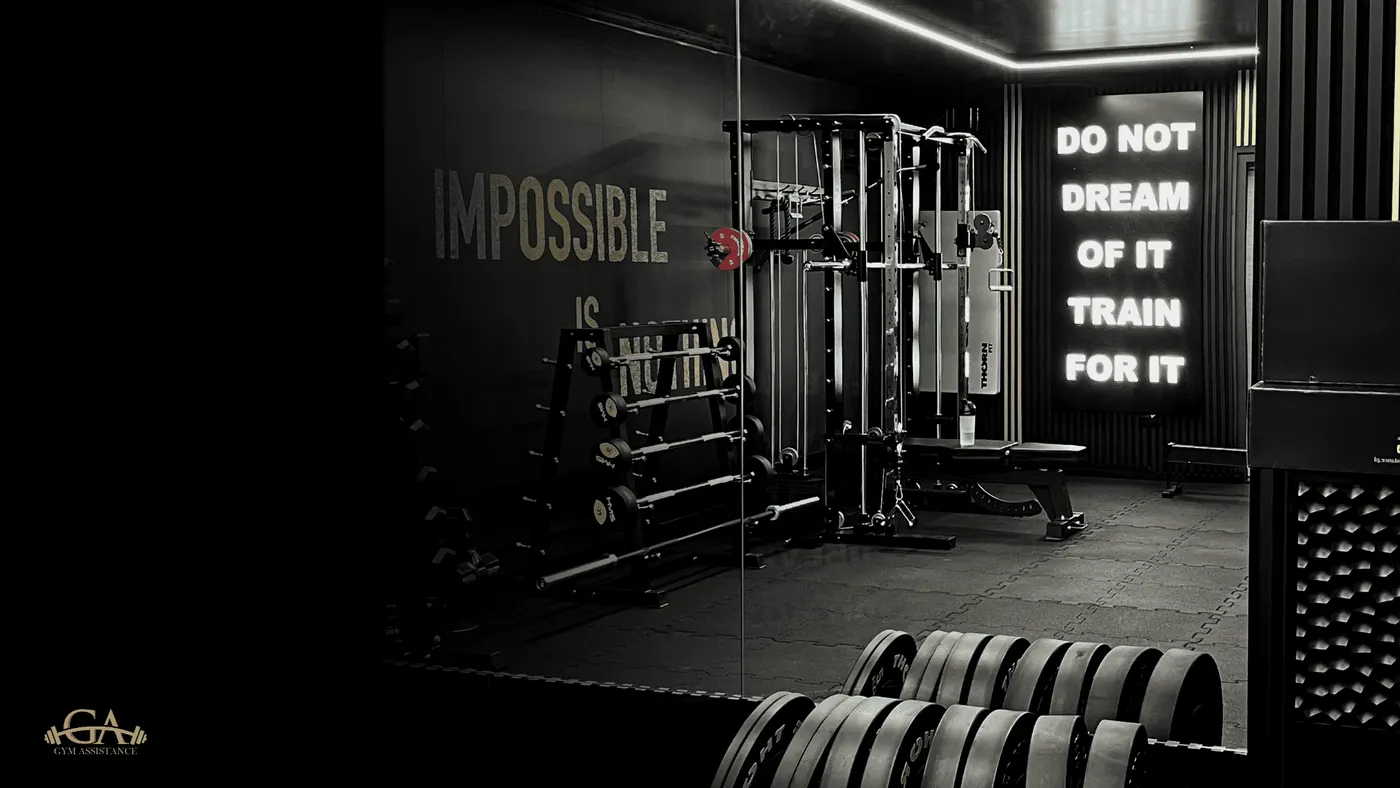
The client and the idea
Piotr from Wrocław has been training for six years. The entire time he was paying a gym membership — around £25 a month — plus the commute and the time nobody counts until they sit down and add it up. When the guest room in their detached house came free (3 × 5 m, exactly 15 m²), his wife suggested that instead of another sofa bed and chest of drawers, Piotr should finally build the “training space of his own” he had been talking about for years.
He had a week to decide, before the room got earmarked for a different renovation. He called us on Tuesday — by Saturday we were on site with a layout.
The challenge: 3 × 5 m and a 2.5 m ceiling
The room has standard proportions, and that’s the good news. 15 m² with a 5 m wall length gives you more single-axis equipment runs than most garage bays. The 2.5 m ceiling clears a pull-up bar, full overhead barbell ROM and free chin-over-bar work for a user up to 190 cm tall.
The challenge wasn’t the geometry — it was Piotr’s exercise list. He trains push/pull/legs, five times a week. He wanted to keep the full range of his existing programme: chest, back, legs, shoulders, cardio and core — no compromises on the exercises themselves. Only compromises on equipment size.
Preparing the room
The room was in good condition, but a few interventions were needed before we could think about kit:
Furniture removal — Piotr handled this himself the day before our installation visit. Room completely empty on arrival.
15 mm rubber flooring — laid over the existing laminate. We specified a 15 mm rolled SBR mat (a compromise between floor protection and ceiling-height savings). Covers the full 15 m². The laminate underneath is protected, dumbbell drops are dampened.
Wall-anchored rack — the compact rack frame was bolted into the load-bearing external wall (solid brick). Four M12 expansion anchors, 10 cm embedment depth. Stability tested under a 200 kg pull-up load.
LED lighting — the old pendant fitting was replaced with two 60 × 60 cm LED panels (5000K colour temperature, 2 × 36 W). Surface-mounted to the plasterboard ceiling with cavity fixings. 400 lx across the whole room — no shadows, no dark corners.
The final equipment
The kit selection followed one rule: every piece must cover at least three muscle groups or three exercise patterns.
Body-Solid GDCC-210 compact rack — 200 × 180 cm footprint, 210 cm tall. Fitted with: high cable (lat pulldown), low cable (rowing), pull-up bar at 207 cm, safety pins for barbell work, attachment points for TRX. One piece of kit replacing six machines.
Marbo 180 cm Olympic barbell — the short 180 cm version rather than the standard 220 cm. In a 3 m wide room a standard barbell can’t be loaded from both ends simultaneously — the 180 cm version solves that. Rubber-coated plate set: 2 × 20 kg, 2 × 15 kg, 2 × 10 kg, 4 × 5 kg, 4 × 2.5 kg. 140 kg of weight total.
Insportline fixed dumbbells 8–28 kg — six pairs in 4 kg increments. Rubber hex heads, stored on a two-tier rack (85 cm wide, 35 cm deep). The rack sits against the short 3 m wall — doesn’t block the through-route along the room.
ATX BT-620 folding adjustable bench — 7 positions from –15° (decline) to 90° (vertical). Folded: 30 cm wide, stands upright against the wall. Flat-position length: 108 cm. Stowed against the wall day-to-day — pulled out in 15 seconds.
Kettler Axos Cycle folding bike — folds to 77 × 47 × 128 cm. Stored under the window or behind the door when not in use. Magnetic resistance, 8 levels, cadence and heart-rate display.
Mirror 220 × 160 cm — tempered glass, bonded to the front wall (facing the rack). Visually enlarges the room and lets you check technique on every exercise.
Audio system — JBL Xtreme 3 Bluetooth speaker on a wall mount by the door. Charged via a USB socket installed at the entrance.
How everything fits into 15 m² — the details
We planned the layout to 1:20 scale before driving over for the install. Here’s how it landed:
- Rack — against the long wall (5 m), 20 cm off the wall (cables need a clearance behind). Takes up 2 × 1.8 m of floor.
- Dumbbell rack — against the short wall opposite the window. 85 cm wide, 35 cm deep. Doesn’t intrude on the central floor.
- Free-weight zone — middle of the room, 2 × 3 m. This is where 80% of the training happens: bench press, deadlifts, squats in the rack, dumbbell work.
- Bench and bike — stored against the wall when not in use. Brought out only for the relevant exercise or cardio session.
- Mirror — front wall, opposite the rack. Visually doubles the perceived floor area.
Things we deliberately left out: a treadmill (the bike covers cardio), isolation machines (the rack and free weights cover them), a permanently set-up bench (folding is the only sensible answer at 15 m²).
Timeline
2 weeks from contract to first session. One week for equipment delivery, one week for installation (flooring, lighting, rack mounting, mirror). Piotr came back from a business trip on the Friday — by Saturday he was doing his first pull-ups in his own house.
Return on investment
£3,000 one-off vs. £25/month membership + £6/month fuel (commute) = £31/month. Payback: a touch under 8 years. Over a 10-year horizon the home gym is around £700 cheaper — and that doesn’t account for the 200+ hours a year you save on the round trip.