
About the Client
Marcin has trained for 8 years. He started at a local gym, moved to home training during the pandemic, and when gyms reopened – didn’t go back. He preferred training alone: no noise, no waiting, no other people’s playlist choices. The only problem was that he lived in a flat and had nowhere to put equipment.
When he bought a house with a garden in Pyrzyce two years ago, the question was not whether to build a gym but how small it could be and still work properly.
The answer: 21 m² is enough. With the right design.
The Gym Box 7×3 Module
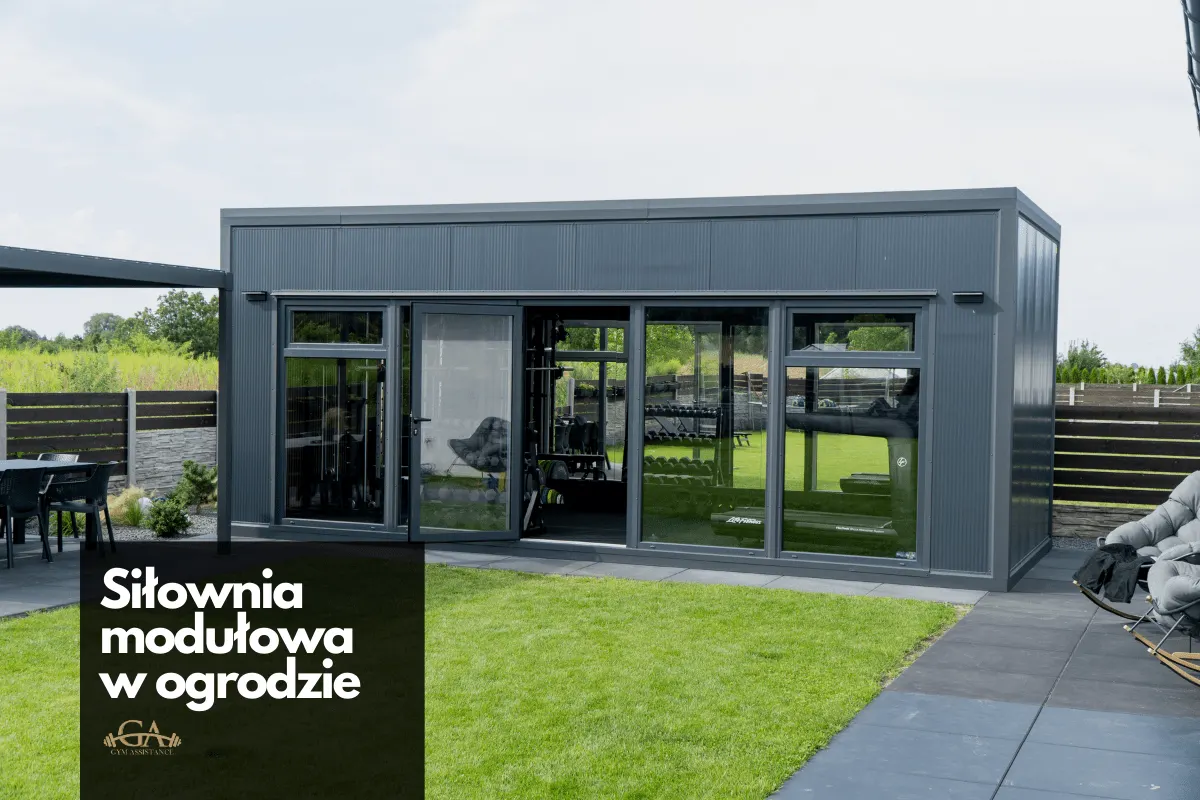
The Gym Box 7×3 is our smallest container module. 21 m² on the floor plan – but that is still larger than many living rooms in UK semi-detached houses, and considerably larger than the spare bedrooms many people try to turn into gyms.
The module was placed on concrete block footings along the rear garden boundary. Ground preparation: clear 8 m² of grass, set 6 blocks. One working day total.
The Design Challenge: a Complete Gym in 21 m²
Here is the honest maths. A standard barbell rack occupies roughly 1.5 m², a bench 0.7 m², a dumbbell rack 0.9 m², a treadmill 1.5 m². That is 4.6 m² of equipment, minus 2 m² for the entrance and circulation, leaving 14 m² of working floor. It sounds tight. For one person training alone, it is entirely sufficient.
The design decisions that made it work:
Multi-function station instead of separate machines. A compact Smith/power rack combination handles squats, bench press, rows and cable work. One piece of equipment instead of four.
Folding adjustable bench. Folded, it occupies 30 cm of wall depth and stands vertical. Takes 20 seconds to set up.
Wall-mounted pull-up bar instead of a freestanding unit. Bolted to the module wall at 210 cm height. Less expensive, takes zero floor space, rated to 200 kg.
Linear layout. Equipment runs along one wall. The entire centre of the floor is kept clear for kettlebell work, stretching, floor exercises and movement drills.
Equipment
Multi-function station with Smith and power rack:
- Smith machine guides for squats and bench press
- Lat pulldown (high cable) and seated row (low cable)
- Integrated pull-up bar
- Safety catches for unspotted barbell work
Free weights:
- Rubber hex dumbbells: 4, 6, 8, 10, 12, 14, 16, 20, 24, 28, 32 kg
- Kettlebells: 8, 12, 16, 20, 24 kg
- Wall-mounted weight storage rack, 40 cm depth
Bodyweight and functional:
- Wall-mounted pull-up bar
- Folding adjustable bench (0°/30°/45°/60°/90°)
- 180 × 80 cm EVA mat for floor exercises
Finishing:
- 15 mm black rubber flooring throughout (21 m²)
- 2.4 × 1.8 m mirror at the machine station
- Tablet/phone wall bracket at eye height for each station
- Towel hook and bottle holder at each position
Services
The Gym Box module arrives pre-wired for electrical connection. Marcin ran a 230V/16A cable from his garage on day one.
- Split air conditioning with heating function (rated to -15°C external)
- LED lighting with colour temperature control – 3000K for warm-up, 5000K for working sets
- 3 wall power sockets
- Ventilated grille with heat recovery
Why This Matters for UK Buyers with Small Gardens
UK terraced and semi-detached properties – the most common housing type in England – typically have rear gardens of 40–100 m². Many potential Gym Box clients assume that a small garden rules out a container gym entirely. It usually does not.
A 21 m² module (7 × 3 m) requires approximately 8 × 4 m of accessible rear garden space including access clearance. That fits into a 40–50 m² rear garden in most cases, particularly if the garden is roughly rectangular.
The Pyrzyce project shows what a single-user strength setup looks like in 21 m². For UK buyers this is the relevant benchmark: the same module, the same approach, the same result.
The Financial Case
The total project cost was approximately £8,400 – structure, insulation, electrics, flooring and equipment. Marcin calculated it against his gym membership (roughly equivalent to £30/month) plus travel costs. Payback period: around 17 years on that comparison. But he has trained for 8 years and expects to train for 30 more – and the asset remains when the membership would not.
For UK buyers, where gym memberships in regional towns average £35–£60 per month, the payback comparison looks more favourable still.