
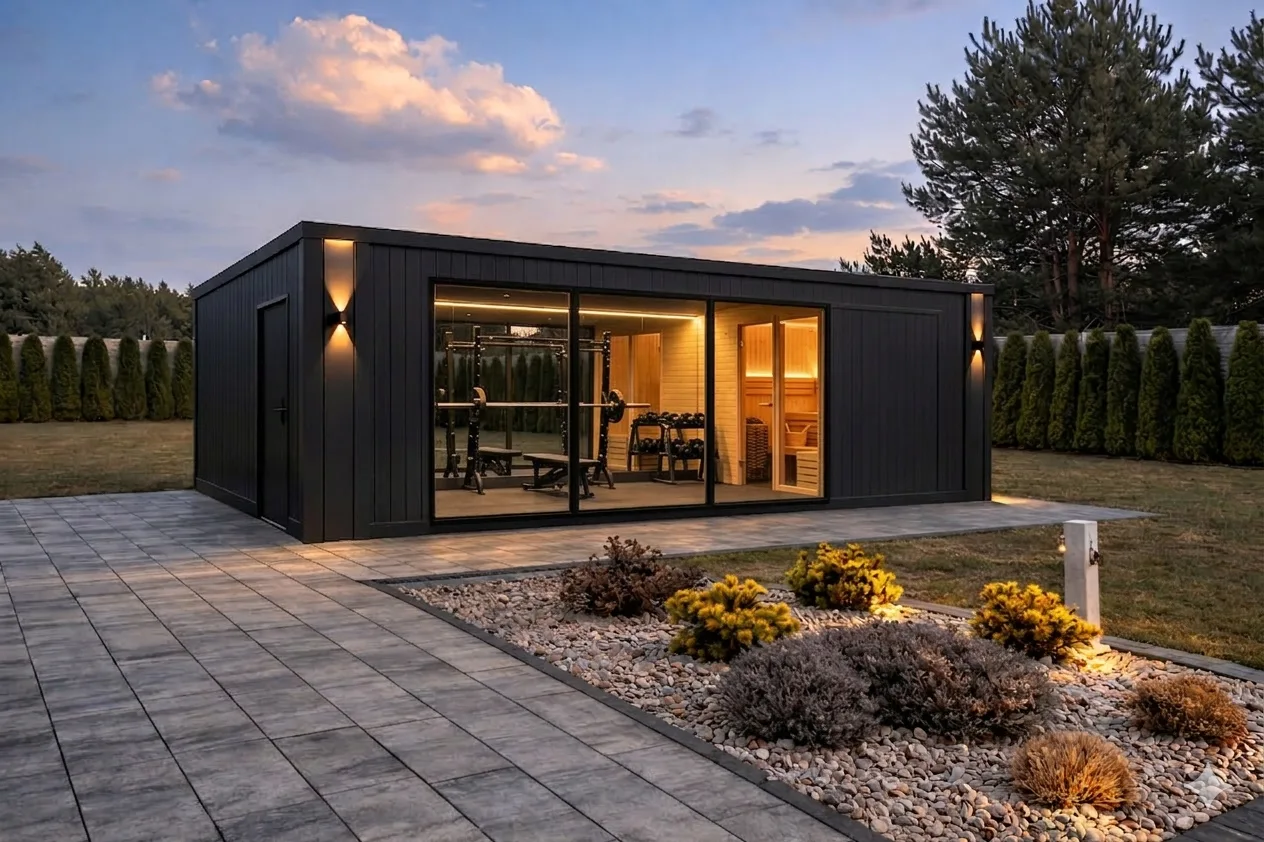
Your own yoga space – why it changes everything
Yoga needs focus, quiet and consistency. None of those are easy in a studio class of 20 people, with loud music, rushing through traffic to get there in time. A GymBox for yoga is a space designed around you – your tempo, your music, your temperature, your ritual.
More and more yoga practitioners – from amateurs to certified teachers – choose a garden module of their own. Not as a replacement for the studio, but as a daily space: 20 minutes in the morning before work, an evening session with incense, a mat that stays rolled out on the floor permanently.
What sets a yoga space apart from a standard GymBox
A gym and a yoga space have different design priorities:
| Element | Gym | Yoga space |
|---|---|---|
| Floor | 15 mm rubber | 15 mm puzzle mat – tatami-style |
| Temperature | 18–22°C | 20–25°C |
| Lighting | Bright, directional | Diffuse, warm, dimmable |
| Sound | Neutral | Soundproofing + a decent speaker |
| View | Optional | Important – windows or glazed wall |
| Mirrors | Mirror wall | Useful for working on alignment |
We design differently for each of these dimensions than for a standard GymBox. That is why we ask about your intended use before drawing up the layout.
Floor – a tatami-style puzzle mat
For yoga and Pilates we recommend a 15 mm puzzle mat – the same one used in tatami studios. It is the best solution for:
- a stable surface under a yoga mat
- knee and foot comfort in floor poses
- mat-based Pilates (without a reformer)
- mobility and stretching work
- hygiene (easy to clean, does not absorb sweat)
Underneath the puzzle mat: PIR or EPS insulation – the floor stays warm year-round, even when the outdoor temperature is below freezing.
Lighting – warm, dimmable, no harsh shadows
Hard directional LEDs are wrong for yoga. They create sharp shadows, distract attention and never build atmosphere.
In a yoga space design we use: ➜ LED strips at 2700 K (warm white) along the upper wall edges – indirect light with no source in your line of sight ➜ Dimmer / regulator – you can drop the intensity to a minimum for meditation sessions ➜ Optional: RGB mood lighting (extra cost)
How much space do you need?
| Use | Minimum area | Module |
|---|---|---|
| Solo yoga (1 person) | 10–12 m² | 8×3 m (part of the module) |
| Yoga + mat Pilates (1–2 people) | 18–20 m² | 8×3 m in full |
| Small group of 3–4 | 25–30 m² | 9×3 m or 6×5 m |
| Studio with reformers | 30–40 m² | 7×5 m or custom |
A standard yoga mat is 180 × 60 cm. For comfortable practice plan for 2 m × 2 m per person (arms extended sideways).
Combination: yoga + functional training
An increasingly popular setup is yoga + light functional training in one module:
➜ Half of the module: a 15 mm puzzle mat for yoga, Pilates and stretching ➜ The other half: a wall bar, TRX suspension straps, kettlebells, a HIIT mat ➜ Boundary between zones: layout change or a sliding textile curtain
This configuration in a 6×5 m or 7×5 m module gives you two functions with no compromise.
Indicative pricing
| Configuration | Module | What the price covers | Indicative price |
|---|---|---|---|
| Private yoga space (1–2 people) | 8×3 m | module only | from £30,000 +VAT |
| Yoga + functional training | 9×3 m | ready package with equipment (Gym Box 9×3 Standard) | from £32,500 +VAT |
| Mini studio – yoga / Pilates | 7×5 m | module only | from £42,000 +VAT |
| Studio with reformer | 7×5 m | module + one reformer | from £47,800 +VAT |
“Module only” means the fitted-out module: structure, insulation, electrics, climate control, the 15 mm puzzle mat, dimmable lighting, acoustic insulation, mirrors, the design and installation. Training equipment on top of that — a reformer, a wall bar, kettlebells — is quoted separately, so compare rows by what each one includes, not by floor area alone. Delivery to your site is quoted separately by postcode.
Want a private yoga space designed for you? Request a quote →
See also: GymBox with Reformer Pilates → | GymBox Train & Recover → | Container Gyms – Full Range →